Sunday, August 17, 2014

Z is for Zinnias

Zinnias and Onions, Oil on Canvas, 20 by 24 in.

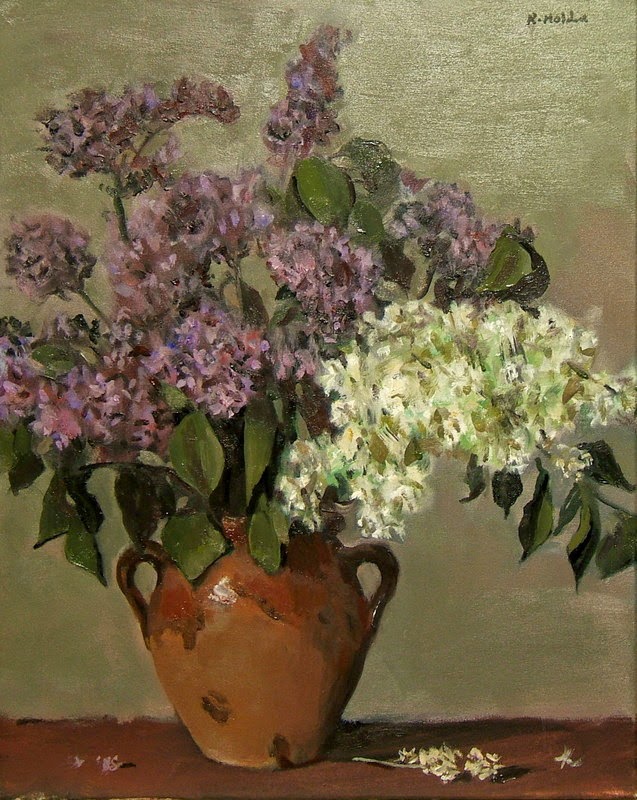
Zinnia Painting described below, Oil on Canvas, 20 by 16 in.

I’ve gotten into a habit of painting pictures of locally grown flowers in the summer, and right now zinnias are in season and being sold at the farmers’ markets near my home studio on Manhattan’s fashionable Upper West Side, a painter’s paradise in The Year of Our Lord 2014, and home to throngs of artists who congregate in the local sushi bars to share trade secrets every evening after an invigorating day painting the urban landscape en plein air.

Two Saturdays ago, around 8:30 a.m., I walked 10 blocks south to the popular Greenmarket that sets up on Thursdays and Saturdays opposite Lincoln Center in Richard Tucker Square, which is actually a small triangular traffic island on Broadway, to see what flowers were available to paint that day.  What follows is a tedious account of a trivial pursuit that occurs with regularity in my humdrum existence.  It’s easier to write a thousand words than to paint a picture. 

Zinnias were being sold by two farms with stalls next to each other.  One of the farms had a dozen or more big plastic buckets jam-packed with large bouquets of zinnias for $6 each, but the zinnias appeared a little bedraggled.  They looked much fresher when I passed by the market on Thursday afternoon on my usual trek down Broadway to the Art Students League on West 57th Street to draw in the late afternoon life sketch class.  I spent about 20 minutes mulling over the selection, getting very little inspiration from the combinations of yellow, orange, red, and light and dark shades of violet in each bouquet.  One large bunch was comprised of a dozen bright yellow zinnias.  I gave that one quite a bit of attention, but decided it would be tough to assemble an attractive still life composition with all that yellow.  There is a lot of truth to something Degas once said, “What a horrible thing yellow is.”  There weren’t enough off-white zinnias in the bouquets to suit my taste either.

At the market stall next door, a young woman creates smaller bouquets on the spot for $5 apiece, so I “impulsively” bought one that looked promising, even though the fresh-looking zinnias were accompanied by stalks of snapdragons in complementary colors.  I have trouble painting the small, amorphous forms of snapdragons.  And it’s difficult to get the flower maven to custom-make an arrangement for me – she has her own way of doing things.  Besides, what do I expect for just five bucks? 

With the flowers now in hand, I wanted to hop on the M104 Broadway bus, which lets me off right in front of my apartment building.  But I didn’t see one coming, so I walked back to my apartment, greatly concerned, as always, that I was shortening the life of these fragile cut flowers by not getting them back in water right away. 

When I got home I cut the stems a bit and put the zinnias in a water-filled glass vase until I decided that this bouquet might look good in my recently acquired and somewhat unusual Japanese coffeepot with a quaintly decorated, flared base.  This turned out to be a big mistake.  But these flowers aren’t going to last long and you have to make decisions quickly.  I threw in some ice cubes in the pot and moved from the kitchen sink to my west/northwest natural light studio in the former bedroom of my apartment.  I plunked the vase down on the ledge of my upturned model stand, which I had draped with a gray cloth that kind of went with the gray background cloth I chose to pin on the wall behind the arrangement.

The ledge of that upturned model stand has lately been the primary staging area for my still life setups.  The sheetrock wall about 18 inches behind the stand is a good surface for accepting push pins to try out different-colored background draperies.  I’m a little depressed about this new use for my model stand, which I built because I love painting faces and thought I might get a little portrait business going when I sacrificed my life to painting years ago. That didn’t materialize.  And the older I get, the less inclined I am to wheedle and cajole people into posing for me.  That never worked for me, anyway.  As it often happened, the only people who wanted to be painted by me were people I didn’t necessarily want to paint.  But sometimes that resulted in a very good painting, so what do I know.  And I simply could not afford to pay for private models on a regular basis.  I’m reminded of Winslow Homer’s comment upon fleeing urban society for the desolate Maine coast when he got older.  “Leave rocks for your old age – they’re easy,” he told a student artist in 1907.  I’ll bet Homer didn’t waste his time painting zinnias.

The gray background cloth I chose for my zinnia painting gradually shifts from cool to warm gray without my permission as the sun heads west.  The important thing is getting the cut flowers down on canvas quickly while they are as fresh as possible, considering how far they have to travel in an urban environment.  If you are lucky, you can always harmonize any background color through trial and error with admixtures of the various flower colors, painting into and around the bouquet while the paint is still wet.

I did two paintings from this bouquet.  I got going on the first one at 10:30 that Saturday morning, about an hour after buying them at the market.  That’s really too late to complete the work in one three- or four-hour session under the same light conditions.  The natural light in my studio is pretty constant from about 8 or 9 a.m. until about 1 or 2 p.m.  But the afternoon sun gives my still life setup a much warmer look, with dark, crisp shadows, which looks great, but I don’t have the energy to start another canvas.  That’s why painters who work alla prima love true north light studios.  They can paint for longer periods without worrying about the colors and values changing dramatically.   I have read that some terrific painters like Sorolla and one of his students, Aldro T. Hibbard, were known to paint for hours outdoors on the same scene and then summon all their creative energy to complete their paintings with dramatic late afternoon light effects.  “Now, Estevenson, now is the time to paint,” a student named Stevenson recalled Sorolla exclaiming at the hour of reckoning.  That’s one painting “demonstration” I would love to have witnessed.

Cut flowers can last a long time unless you intend to paint them.  Then they start wilting and taking on different shapes immediately just to spite you, so you have to paint rapidly.  I’m familiar with a lot of different approaches to painting flowers from life.  Some artists paint the vase and surroundings first and add the flowers later, or vice versa.   As I’ve written before, Fantin-Latour painted the flowers against a background color he prepared the night before, and then painted like blazes on the flowers he had just cut moments before from his backyard garden, finishing them mostly in one session.  He then could complete the vase and touch up the flowers a bit at a comfortable pace the next day.   Some artists do a careful drawing of the design and paint one flower at a time.  Some take a flower and turn it several different ways to fill out the arrangement.  Some write books on how to paint flowers their way.  Some artists stoop to painting silk flowers.  Some even copy photographs of flowers, I’m told, as Cezanne’s dealer Vollard said was done by “the father of modern painting.”   And take note of what one of my teachers said about photographs of paintings when you look at the images of my zinnia paintings displayed with this blog post:  "A bad painting photographs better and a good painting photographs worse," said the late Frank Mason.  I don't think he was talking about just plain bad photography, though.  

Lots of determined realist painters avoid painting flowers from life altogether because they are restless models that can’t hold a pose.  It’s quite a challenge to figure out how to avoid a real disaster when painting flowers alla prima. 

I learned to paint directly from nature by working pretty much over the whole canvas without a preliminary drawing on paintings up to 24 by 30 inches or so.  This approach suits my impatient personality.  With turpentine-thinned oil paint, I indicate the approximate boundaries of the entire setup on the canvas.  The color of the paint I sketch with doesn’t matter much to me,  although it is usually raw or burnt umber.  I then move from flower to flower to estimate their relative positions by holding a brush handle at the proper angle.  When the rhythm of the design takes shape, I start washing in a thin local color for each of the flowers in their approximate shape before building up the paint.  I like to work from light to dark colors, hoping I can get by with using fewer brushes that way.   After that, I tend to forget what comes next.  I’m too busy painting to conjure up any real-time analysis. 

I sometimes wish I could be as analytical as other painters, but the act of painting for me is more of a spontaneous emotional experience than a meditation, and I can’t remember what I did from one painting to the next. 

On that score, many artists often have no idea how they produced a successful painting.  I can thank the eminently quotable Degas again for supporting that observation. "Only when he no longer knows what he is doing does the painter do good things," said Degas.  I’ve known a few artists who find it extremely difficult to copy their own work when necessary because they can’t remember how they painted it.  A portrait painter friend was asked to recreate a woman’s portrait he had painted many years ago so the second of the woman’s two daughters could also have this wonderful portrait of their late mother. He said it was a most difficult assignment.

The first painting I did of these zinnias is just a formal arrangement, front and center, without any serious design effort, other than initially shuffling the flowers until the arrangement looked balanced and harmonious, at least to me.  As when painting all my subjects, I try my best to get the flowers to appear to exist in the same atmospheric space they occupy in my studio.  In my moderately impressionistic way of painting, I suggest the most obvious details, rather than try to render all the petals perfectly, which is really a tedious operation and beyond my patience and skill level.  There’s not much to say about this process.  It’s all just pushing the paint around to make the flowers on canvas look and feel right in the atmosphere that surrounds them.  I painted the zinnias pretty completely in the first three-hour session, but I had some trouble with the snapdragons.  I was pretty sure their plump little bell-like shapes wouldn’t change much in 24 hours, so I left them unfinished for the second painting.  But the next day, they had veered out of position in such a way that I was forced to invent a larger shape for the snapdragon stalk on the right to balance the composition.

Flower painting is hard enough, but painting that fancy coffeepot really drove me crazy.  The frieze at the top and bottom of the vase is a delicate floral design that is indistinct from my vantage point a couple of feet away.  I worked very hard to keep it as restrained as possible so it wouldn’t dominate the composition.  And I repositioned and repainted the body of the pot to have it straight on rather than at a slight angle as it was initially, which I hadn’t noticed until the second day.  It just didn’t look right probably because I was painting it as if I were viewing it head-on.  The bluish-white body of the coffeepot was giving off a beautiful glow and it was exciting to lay in the color with a big brush fully loaded with paint.  It looked fantastic until I had to subtly indicate the bulbous segments of the porcelain façade.  I threw in a snappy highlight and signed the painting, feeling pretty good about my effort.  But I then noticed that the symmetry was way off on the right side of the flared base.  As Sargent said, most of us have a bias to one side and painters should always have a plumb line handy to deal with symmetries.  I think a lot of us just paint some junk to camouflage one difficult side of a symmetrical object to avoid grappling endlessly to get it to seem right to our “biased” eyes.  Some artists like to draw such things perfectly before beginning to paint, but painting around a careful drawing is a technique I’m not much interested in.

After quite a number of tries to improve the symmetry, I was ready to give it up and come back for a fourth session -- way too much time for me to spend on a simple still life.  I was getting very agitated.  But about an hour before I headed off to draw at the League again in the late afternoon, I became frantically obsessed with this problem.  I had to find a solution.  I took my paints out of the freezer again and threw down the flower at the center right of the bouquet to hide the right side of the flared base of the pot so I could sleep that night.  

The paint was still pretty wet, but there was no way I was going to wait for it to dry in a couple of days to calmly add another flower over the dried surface or come up with another solution to my problem in the clear light of day.  So I really juiced up the cold paint with my trusty half-oil medium of stand oil and turps so the flower would stand up without becoming like Dali’s painting of watches, The Persistence of Memory. After 30 minutes of panicked hard labor I was finally through with this one.  I had said all I wanted to, and to be honest, all I could say.  What a relief!   Now my sun was shining again.  And later that afternoon I had one of my best life drawing sessions of the summer at the League.

The next day I took another newly acquired pot, put a few of the surviving zinnias in it, added an onion that’s been lurking at the end of the ledge for about two months now, and painted this small still life basically in one session.

Today at the farmer’s market on Columbus Avenue at West 77th Street it was cosmos from one vendor and two sunflowers from another.  I must be crazy to keep torturing myself this way.  Point me in the direction of those Maine rocks.  Oh, Lord, I'm on my way!

The Second Painting, Oil on Canvas, 14 by 12 in.

Oil on Canvas, 18 by 15 in.

Oil on Canvas, 24 by 18 in.

Tuesday, August 5, 2014

The Rings of Denmark


Laurits Andersen Ring (1854-1933), Sommerdag ved Roskilde Fjord, 1900, Oil on Canvas, 37.4 by 56.7 in., Randers Kunstmuseum, Denmark


L.A.Ring, At Breakfast, The Painter’s wife, Sigrid Kahler, 1898. This beautiful painting is in the collection of the National Museum in Stockholm, Sweden, which does not publicly disclose the dimensions of the work online.  How strange!

Ole Ring (1902-1972), The Still River, Oil on Canvas, 14 ¼ by 20 in., Private Collection

Ole Ring, A Sunny Day in Hellested, Oil on Canvas,13 by 19 ¾ in ., Private Collection
If you’ve been making art since you were knee-high to a grasshopper and decide for some peculiar reason to become a painter when you reach the age of consent, it’s advantageous to have a father or mother in the business so you don’t think it’s such a dumb idea to begin with.  Throughout the history of art, there have been numerous painter dynasties, including the Holbeins and the Breughels, Elder and Younger.  The late Richard V. Goetz (1915-1991), who taught painting at The Art Students League, my daycare center, and his wife, Edith, also a painter, had six children, and four of them became artists themselves. 

In days of yore, when painting was considered a highly skilled craft with rules and regulations, lots of kids were apprenticed to the trade through family connections of one sort or another.  Even that eccentric genius Vincent van Gogh took inspiration and instruction from a near-relative, Anton Mauve, a cousin-in-law.  Van Gogh revered Mauve (1838–88), who introduced him to painting in both oil and watercolor and lent him money to set up a studio before they had a falling out when Vincent took up with a pregnant prostitute.  Mauve apparently thought that was a bit too much, so he ended his association with Vincent.


Anton Mauve (1838-88), Morning Ride on the Beach, 1876, oil on canvas, 17.7 by 27.6 in, Rijksmuseum, Amsterdam.  Years ago I copied a print of this brilliantly composed, dramatic painting, and a collector liked my copy enough to pay me a few dollars for it.
Right now I’ve been thinking about the two Rings, Laurits Andersen Ring (1854-1933) and his son, Ole Ring (1902-1972), both excellent Danish painters you don’t hear much about in America unless, perhaps, you follow the art auction circuit. 

Laurits was one of the foremost Danish painters at the turn of the 20th century.  A convert to atheism, he is credited with introducing symbolism and social realism to Denmark’s art world, two styles of painting that he juxtaposed throughout his long and productive painting career.  His painting Summer Day by Roskilde Fjord, which is in the Randers Kunstmuseum in Denmark, is considered one of the masterpieces of Danish culture.  There is an extensive collection of his paintings and drawings in the National Gallery of Denmark in Copenhagen and there are there are examples of his work at practically every Danish art museum.

As with so many of the wonderful 19th Century and early 20th Century painters, there are a lot of interesting tales to be told regarding Laurits Ring’s private life, just behind the magic curtain of his marvelous paintings.  These hidden stories wear you out in the retelling, even if you are just copying Wikipedia entries.  But they are worth the effort for the most part because they reveal the often surprising humanity of  these great painters, while your own life is as boring as toast, spent mostly laboring clumsily on your own canvases and wishing you could paint half as well as they could..

L.A. Ring was born Laurits Andersen in the village of Ring in southern Zealand, the largest of Denmark’s islands where the Capital of Copenhagen is located.  Ring's father was a wheelmaker and carpenter and his mother a farmer’s daughter.  At the age of 15, Laurits was apprenticed to a housepainter because his older brother was destined to take over their father’s business.  In 1873, the opportunity to go to Copenhagen arrived when a local merchant hired Laurits to do some paintwork in the Capital.  While in Copenhagen, Laurits studied painting privately for two years and in 1875 was accepted at the Danish Academy of Arts.  Ring disliked the Academy’s strict classical studies in drawing but stayed on for three years.  He also studied briefly with one of my idols, the great Norwegian painter Peder Severin Kroyer, whom I wrote about in an earlier post.

In 1881, Laurits Anderson and his friend, the painter Hans Andersen from the village of Brændekilde, decided to take the names of their native villages in order to avoid confusion at their joint exhibition.   So Laurits became L. A. Ring, and Hans became H. A. Brendekilde, who happens to be another excellent Danish Realist.  

Ring became increasingly interested in the difficulties of the poor and social justice for the lower classes during a period of political turmoil in Denmark in the early 1880s.  The Prime Minister, J.B.S. Estrup, had unilaterally suspended the democratic decision-making processes laid down in the Danish Constitution to enact some social and financial reforms.  Ring was active in the "Rifle movement", a revolutionary group of students taking up arms training in preparation for a rebellion.  But the opposition forces reached a consensus with Estrup’s initiatives and there was never any civil violence.

The young painter had other things on his mind as well.  In Copenhagen he became a close friend of the family of lawyer and amateur painter Alexander Wilde. He spent Christmas and summers with the family and formed a “very close” friendship with Wilde's wife, Johanne.  Ring and Mrs. Wilde exchanged “frequent and intimate” letters and he painted many tender portraits of her, but nevertheless she remained faithful to her husband.  Realizing the hopelessness of his passion for Johanne, he broke off his relationship with the Wilde family and became severely depressed, as always happens in these cases of unrequited love, I’m led to believe.

L.A. Ring, Johanne Wilde at her Loom, 1892, Oil on Canvas
Word got around.  In 1894, Ring was used as a model for a character in the novel Night Watch (Nattevagt) by the Danish author Henrik Pontoppidan, an old friend of his. In the novel, Ring is the unflattering character Thorkild Drehling, a painter and failed revolutionary, who was in love with his best friend's wife.  Ring apparently did not object to the unflattering depiction, but he was offended that Pontoppidan would publicly divulge his infatuation with Johanne Wilde in that way.  Deeply hurt by Pontoppidan's betrayal of confidence, Ring broke off this friendship as well, never giving an explanation.  These artists’ types are super-sensitive, aren’t they?

After a year of painting in Italy, Ring recovered his composure and started working in 1895 on a series of paintings with fellow painter Sigrid Kahler as a model. She was the daughter of ceramic artist Herman Kähler.  Ring married Kähler in 1896 when she was only 21 and he was 42.  The couple had three children, including Ole, their painter son, before Kähler died of lung cancer in 1923 at the age of 49.

Once he became a family man, Ring seems to have given up sowing any more wild oats.  Now it was just boring medals and honors for this Great Dane, and astute analyses of his painting themes by hard-working art critics and historians who get paid to explore such things.  Ring’s decision to become an atheist apparently had a profound effect on his work and “he began to explore motifs and symbolism that contrasted forces of life and death,” according to a contributor to Ring’s Wikipedia entry. “Others have interpreted the drive towards unsentimental realism as an expression of Ring's atheist life stance,” the author continued.  Ring’s biographer Peter Hertz neatly summarized the painter’s  life and work:  “His oeuvre remains as his life and essence: The still water of profound depth.”

L.A. Ring’s son, Ole, painted similar subjects in a style highly influenced by that of his father.  There are lots of images of his highly accomplished work online and many of his paintings have been sold at auction.  That’s all I know about Ole Ring, the son of L.A. Ring.  And I’m so happy about that, between you, me and the lamppost.

L.A. Ring, Walking in a Rye Field, 1905, Oil on Canvas, 27 ¼ by 22 ½ in., Private Collection

L.A. Ring, Village Street in Baldersbrønde, Oil on Canvas, 1905, Aarhus Kunstmuseum, Denmark

L.A. Ring, The Artist’s Wife by Lamplight, 1898, Oil on Canvas, 68 by 87 cm, National Gallery of Denmark, Copenhagen

Ole Ring, Ugledige, Denmark, Oil on Canvas, 11 by 16 in., Private Collection

Sunday, July 27, 2014

Copying Paintings


More than 110 artists competing during a timed “facsimile match” in Dafen, China on Thursday, May 18, 2006


 Ilya Repin, Portrait of the Art Critic Vladimir Stasov, 1883, Oil on Canvas, 74x60 cm, Russian Museum, St. Petersburg, Russia


(Left) John Singer Sargent, Head of Aesop, Copy after Velázquez,1879, Oil on Canvas, 18 1/4 by 14 5/8 in., Ackland Art Museum, The University of North Carolina at Chapel Hill.  (Right) Diego Velázquez  (1599-1660),  Aesop (Detail), 1640, Oil on Canvas, 179x94 cm, The Prado, Madrid

Since signing up with Etsy, the online marketing website for artists and artisans, I have neglected this occasional blog of mine, which was initiated to serve as a personal catharsis and nothing more -- and maybe even a lot less. 

In the short time I have authored this blog, I have very much enjoyed entertaining myself by writing some irreverent rants about the current state of the art business for representational painters and retelling some stories about painters from the past.  But now that I have my very own virtual fine art gallery on Etsy and have fully accepted the digital marketplace, I might just as well write a little bit about my own painting activity to accompany my usual subject matter.  In case you are curious, here’s the link to my Etsy gallery: https://www.etsy.com/shop/RobertHoldenFineArt

Meanwhile, though,  I recently read a blog post regarding the copying of paintings, and it got me to thinking about this time-honored practice, which I believe I wrote about in an earlier post, but I don’t have a search function for this blog so it’s not so easy for me to check.  At any rate, artists at the beginning of their careers have always copied the paintings of great artists to try to learn something about technique or simply to honor one of their favorite painters. I copied a few paintings from prints years ago and sold a couple of them through happenstance, my sales rep.  I never copied directly from a painting in a museum though.  I try to avoid crowds of tourists looking over my shoulder when I am  painting.

You don’t really learn much about the process of painting by copying a great painter’s work.  Rembrandt will not be holding your brushes when you are facing the real thing and your canvas is blank.  But you can rejoice in confirming the greatness of a painter you admire when you closely examine one of his paintings and intuit how right everything seems to be in contrast to your own abysmal efforts.   I once copied a print of Ruben’s great allegorical painting The Meeting of Marie de' Medici and Henry IV at Lyon and it enabled me to fully appreciate the powerful design of this masterpiece.


As I believe I wrote in an earlier post, the Impressionist Renoir, whose early paintings I really admire, didn’t think much about the practice of copying paintings, even though he drew inspiration from the works of a number of Italian Renaissance and French artists hanging in The Louvre.  He had this to say about copying: “Go and see what others have produced, but never copy anything except nature. You would be trying to enter into a temperament that is not yours and nothing that you would do would have any character.”  I think he is absolutely right about that.

I knew a painter who had a sideline business copying paintings at the Metropolitan Museum of Art some years ago.  Charlie’s copies of the Old Masters were good enough to attract buyers, but he wasn’t very good at painting from life, as we witnessed the few times he painted with us at the Saturday open painting class for members of The Art Students League.  I’ve also known a couple of very good painters in their own right who copied paintings at the Met to make a little extra money. One of them scored the storefront window of a major portrait broker in New York City with his excellent copy of a Sargent portrait.

But most copyists can’t possibly gain any significant practical benefit from their labor, no matter how diligently they experiment with the presumed colors used by the great artist, because they just peck away for days to get a superficially exact copy of a painting that may have been completed in two or three hours with a simple palette and a skilled brush handling technique that is beyond the copyist’s ability to imitate.  Better to follow the example of Sargent, who dashed off some very impressive copies of Velazquez in his own bravura style to study the underlying structure he observed in his idol’s work.

On the other hand, the general public unfortunately has a huge appetite for soulless copies of paintings of famous artists.  Art factories have been around for quite some time in the United States and other countries as adjuncts to the home-decorating industry.  But the most egregious manifestation of the business of copying paintings can be found in the fertile, nearly tropical climate of South China’s Guangdong Province.  Within the past 20 years, Chinese entrepreneurs in that province have taken this business of copying paintings to incredibly outrageous levels of marketing, thus furthering the cultural debasement of this once-great civilization, which in past centuries contributed so much beauty to the world of high aesthetics. 

According to various Internet sources, as many as 5,000 artists work at copying paintings for the global art market every day in one art “sweatshop” in Dafen, one of 10 artist-villages in Guangdong Province.  This enterprise reportedly produced 50,000 paintings in a month and a half for Walmart.  It is said that artists in these art factories have produced 60 percent of the world’s paintings by slavishly copying just about every painting that was ever painted by a well-known artist in days gone by.  The village exports about five million paintings every year!  The fastest workers can copy 30 paintings a day!  I would be mortified to learn that these speed merchants are able to accurately copy detailed photographic images of Rembrandts and Vermeers at that rate!  But if they are copying Picasso, Matisse or Jackson Pollock, then I suppose it’s quite possible to achieve such numbers.  On second thought, exactly copying one of Pollock's random "drip paintings" might be impossible.  One reason some painters are proud of their  bold, somewhat sloppy and accidental alla prima approach to realism is that it is harder to make an exact copy of their work.

The image at the top of this post is a photograph showing more than 110 artists competing during a  timed “facsimile match” in Dafen on Thursday, May 18, 2006.  They are copying a photograph of Ilya Repin’s 1883 portrait of the art critic Vladimir Stasov.   Many of these copyists are artists who have been well-trained in the rigid art academies of China, which are modeled on the art academies established in Russia by the great Repin and his fellow Realist painters in the late 19th Century.   In my humble opinion, these copyists are disgracing the memory of this great artist by mechanically copying, as fast as they can and for eventual export to the global market, no doubt, a photograph of this painting, which Repin created when he was in full stride at the age of 39 after years of honing his craft with all his heart and soul.  Repin would not be amused. 

By the way, there are so many online images of this Repin portrait -- and they all look exactly alike -- that I have no idea whether they are all the same official photograph of the original painting in the Russian Museum in St. Petersburg or whether some are exact photographic copies on canvas of the official photograph of the original painting and were produced at one of those Chinese painting factories.  When I last visited Google, there were 139 images of Repin’s portrait of Stasov on 139 individual websites.  I’m not about to click on every one to see if I can spot any “facsimiles.”  I think the one I've chosen to reproduce is the one I found on one of the Wiki websites, which claims its image of the Repin portrait “is a faithful photographic reproduction of a two-dimensional public domain work of art.”  With my post, Google now has at least 140 images of this painting.

If you have access to a good printer, couldn’t you just download one of those images and print it on high-quality, canvas-textured paper yourself?  Digital printing can reproduce the smallest details of a high-resolution digital photograph of a painting far more accurately than any painter can.  Still, it’s probably cheaper to buy a Chinese knock-off.  A nice frame for your print would probably cost more than the whole package from China.

And finally, at least as far as I am presently concerned, maybe I shouldn’t get so upset about this business of copying paintings for the global art market.  Painters have always cited music and art as the two essential ingredients for a happy life.  The works of Mozart and other great composers are readily available on recordings and live performances for all the world to enjoy.  Maybe there really is nothing wrong with copying the works of great painters so they can be enjoyed by everyone in the privacy of their own homes, not just by those who are friends of the rich guys who own the Rembrandts.

I’m not convinced, however.  Serious music is performed seriously with loving care by serious musicians who rehearse long and hard before the performance so they can properly display and venerate the genius of Mozart.  Despite all the “attention to detail” claims on the websites of these art sweatshops, somehow I don’t think a half-hour copy of a Rembrandt painting from a photograph that is destined for Walmart and made by kids right out of art school in assembly line fashion is in the same league.  I could be wrong.  Maybe that’s all the high art we can stomach. Look at all those daily painters in America slavishly copying photographs to create 6x6 in. paintings of teacups, strawberries and puppy dogs for the global market!  Now that Walmart copy of an Old Master painting  produced in a Chinese art sweatshop from a digital photograph doesn’t seem so shameful, does it?

Friday, July 4, 2014

A Pin-up for the 4th

Gil Elvgren, Looking for Trouble, 1953


I notice that a few bloggers have marked our nation’s Independence Day in some fashion, so I thought I would do the same.  Since I’m no longer interested in the patriotic folderol surrounding the event, I’ll just sit home by the computer this evening and waste a little more time creating my own trifle regarding this national holiday.

I remember once watching the annual fireworks display from a very high floor in one of the old World Trade Center buildings at a little viewing party thrown in the office of an acquaintance about 25 years ago.  I found the view of the fireworks display looking down on it to be far less thrilling than looking up at it.  But the crowds actually attending this event at ground level are unbearable, so I no longer bother leaving my apartment to venture riverward – east or west, depending on the promoter’s whim.  None of my fireworks forays in my youth resulted in particularly pleasant memories, anyway – some memorably unpleasant, as a matter of fact. The holidays, including this one, however, are excellent days to stay home and paint on a still life.  I believe there is something inherently noble about engaging in an activity that is so far removed from the media spell cast on the entire country.  It’s like being a martyr for the cause of painting.  And sometimes I paint a little better on such occasions.

At any rate, I found the perfect image for this national celebration in a 1953 illustration by Gil Elvgren, the best pin-up artist by far of all those great illustrators from the 1930s to 1960s who plied the joyous trade of depicting feminine pulchritude at its peak.  I saw a show of his pin-ups in a Soho gallery some years ago and was smiling about it for days afterward.  He used photo references, of course, but he started out with pretty Minnesota girls under the age of 21, and could draw so well that you don’t look at his illustrations and immediately say “photograph.”  You just smile and admit that those luscious figures he painted are simply fabulous.

By contrast, that same show included a portrait Elvgren did from life -- his wife, as I recall.  And it cheered me a little bit to realize that it wasn’t very good.  Same thing with Norman Rockwell and a lot of other great illustrators.  They all wanted to paint like Sargent or Zorn, et al, in their illustrations, as Andrew Loomis wrote about in his comprehensive book, Creative Illustration, but they couldn’t come close when faced with the real thing in front of them. Yes, there is a great divide between illustration and real painting.  But don’t tell anybody, because you will just get cussed out.

Anyway, enjoy the 4th of July if you must.  The sun comes up tomorrow.

Wednesday, July 2, 2014

Becoming an Artist, Virtually


Ginger, the Cat, doesn't pay much attention to my paintings

Well, I couldn’t stand it any longer, so I just signed on with Etsy to become a virtual artist with a virtual gallery and a virtually unlimited worldwide viewing audience for my paintings.  The idea of Etsy is very intriguing.  Trying to get into a real gallery in New York City, or anyplace else, for that matter, is almost impossible, given the incredible number of “emerging” artists prowling around these days with their digital portfolios full of images of pretty darn good paintings.  The art world is full of what Noel Coward said about the stage, “implacable ambition.”

And I know that at my advanced age I will never acquire an idyllic storefront gallery in some quaint tourist town where I can sit all day and wait for the occasional unsuspecting tourist to drop in to admire my paintings and walk out without buying a single one of them.  I think I would really love that kind of life.  I had paintings for a long time in a Soho gallery that was operated along those lines.  If people bought the paintings the owner liked well enough to display, that was fine.  If they didn’t buy them, that was fine also.

Etsy makes it very easy for any artist to set up a virtual storefront gallery with the potential for unlimited virtual tourists to drop in unannounced.  Maybe they won’t buy anything either, and I have some concern that not all visitors to the online marketing sites are square shooters.  But at least my paintings will most likely be seen by someone other than me and Ginger, the cat, who doesn’t pay much attention to them, unless she can scratch her chin against the edge of the canvas.  And who knows, maybe I actually will do a little shipping and handling in the real world because of Etsy.  That would be very nice.  I need to make room for all the new paintings I plan to keep making, the Good Lord willing and the Creek don’t rise, as they used to say when the world was a kinder, gentler place, at least if you didn’t think too hard about anything, the fish were biting and you always rooted for the home team.  

I really don’t have much to say at this time about my new adventure.  I’ve always hated to talk about my paintings with all the people who know me, in the non-biblical sense of knowing, of course.  But in the vast world of the Internet, somehow it doesn’t seem such a hard thing to do – talk about my paintings, that is.  I’ve often longed to tell people about how I acquired a particular object to put in a still life, and all the struggles I went through to get a reasonable facsimile of the things I was painting.  I can see myself blathering on interminably about the most mundane of my paintings.  Dealing with strangers is always more satisfying than dealing with people you know.  When I worked at the Information Desk at the Metropolitan Museum of Art, my young colleagues would time me out at around 20 minutes as I talked about the museum’s glories with polite visitors whose main interest was finding the nearest bathroom ASAP. 

I’m mildly excited about this new venue for showing my paintings, and invite anybody who might have read down this far to take a look at my Etsy site.  Here’s the link:  https://www.etsy.com/shop/RobertHoldenFineArt.   I’ll try to write something less self-serving in my next post – maybe something about “hearing voices” when I paint.  Nothing strange about that for an artist.

Sunday, June 15, 2014

A Museum Director


Jose Villegas y Cordero, The Slipper Merchant, 1872, Oil on Canvas, 19 x 25.6 in., The Walters Art Museum, Baltimore

Jose Villegas, Ladies in a Garden, Oil on Canvas, 16.93 x 22.83 in., Private Collection

Jose Villegas, The Tennis Player (Pablo Ramos Villegas, the Artist’s nephew), 1905, Oil on Canvas, 74 ¾ x 35 ½ in., Private Collection   
Most directors of major museums today have art history backgrounds, but when great European museums such as The Louvre, The Prado, The National Gallery and The Tate were getting started, painters ran the show.

Jose Villegas y Cordero (1844-1921), for example, was a very accomplished painter who served as Director of The Prado from 1901 to 1918.  He had a fine sense of color and could draw extremely well, thanks to rigorous academic training.

Villegas y Cordero began his studies in his early teens at the School of Fine Arts in his native Seville.  When he was 23, a patron sent him off to Madrid to study with Federico Madrazo, a member of the illustrious Madrazo family of painters.  Many years later, Villegas was to follow his mentor as Director of The Prado.  Federico, in turn, had succeeded his father, Jose de Madrazo y Agudo, who served as Director of the Prado from 1838 to 1851.  I’m getting unjustly sidetracked here by associated data, but the Madrazo family also includes Federico’s son, Raimundo de Madrazo y Garreta (1841–1920), the most well-known of the formidable Spanish painting clan and one of my favorite painters.

In Madrid, Villegas made frequent trips to The Prado to copy Velazquez, whose work inspired him to develop a loose and spontaneous manner of painting, according to his biographers.  Villegas also admired the exuberant brushwork and Orientalist works of another teacher, Mariano Fortuny y Marsal (1838-1874).  Villegas went on sketching trips to Morocco to gather material for his own Orientalist paintings.  For a number of years, he had a very successful career in Rome and Venice, painting Orientalist, History and Italian Renaissance themes.  In Rome, Villegas inherited the mantle of Fortuny, who died in Rome from a malarial fever he contracted while plein air painting in the summer of his 36th and last year of life.  By the way, Fortuny was married to Federico Madrazo’s daughter, Cecilia, in case you didn’t know.  There was a lot of social networking among painters in the 19th Century. 

One of Villegas’ Orientalist paintings online is The Slipper Merchant, which is in the collection of The Walters Art Museum in Baltimore.  The Museum has this to say about the painting:  “In the dimly lit, richly colored interior of a North African shop, a turbaned merchant serves a customer seated on a divan. Kneeling in front is an attendant, and barely discernible in the background is a craftsman at work. To the left, a man smokes a hookah. Villegas has adopted a subject made popular by Mariano Fortuny, but rather than exploring light effects, he provides an almost overwhelmingly detailed array of bric-a-brac. Even the picture frame, custom-ordered for this painting, is inscribed in Naskh script: "There is no God but Allah and Mohammed is his Prophet."

Near the end of his very successful career in Rome, Villegas was named Director of the Spanish Academy of Fine Arts in Rome.  Two years later he left for Madrid to become Director of The Prado.

I wonder what the museums would be like today if painters still called the shots, rather than medieval tapestry scholars and the like, who have to behave like high-end carnival barkers to pull in the crowds.  All the old painters I’ve met remember the halcyon days when they had the painting galleries all to themselves whenever they visited the Metropolitan Museum of Art.  Wouldn’t it be nice to return to those golden days of yore?  Fighting through hoards of bewildered, bored and bellicose tourists is pure torture for any lover of painting.

Mario Fortuny, The Odalisque, 1861, Oil on Cardboard, 22.4 x 31.9 in., Museu Nacional d’Art de Catalunya, Barcelona

Raimundo de Madrazo y Garreta (1841-1920), Fond Memories, Oil on Canvas, 32 x  36 in., Private Collection

Monday, June 9, 2014

What if I am?


The BBC had a long-running television show called “The Good Old Days,” which recreated the spirit and look of the British music hall of the “Gay 90’s,” to the extent of having the members of the audience dress up in period costumes and sing along to some of the tunes.  The show ran from 1953 to 1983.  I had never seen it until somebody uploaded a bunch of highlights onto YouTube a couple of years ago.

One of the acts was a little guy wearing a snappy red bandleader outfit, with a big bass drum strapped to his back and cymbals fixed on top of his head.  He performed a frantically comic version of “McNamara’s Band.”  When he first pranced onto the stage in this ridiculous getup, he stopped, looked squarely at the audience and, with a scowl on his face, declared, “What if I am?” in a defensive tone.  He got a big laugh.

“What if I am” is a neat phrase that has been sneaking into my thoughts lately.  It would make a good title for a motivational self-help book with a confrontational bite to it.  You might also say, “I’m doing my own thing and what’s it to you.”  Might be a best-seller on Amazon.
.
Not that it matters to anybody else, of course, but that’s kind of how I’ve conducted my negligible painting career for many years.  I have no interest in following the crowd to make a buck.  I have absolutely no burning desire to blaze new ground with my painting.  The things I like to paint are simply the beautiful things painters have always painted from life. Accurately recording any old scene from contemporary life, like strip malls with lots of utility poles, traffic lights, signage and parked cars in them, or village intersections with lots of utility poles, traffic lights, signage and parked cars in them, or urban environments with lots of utility poles, traffic lights, signage and cars in them, as former advertising illustrators and graphic designers are good at doing, is not for me.  Snapshots tell you all you want to know about such scenes.  We are advised to paint 24/7 and not wait for inspiration.  But it seems to me there’s no point to painting, or engaging in any creative art, for that matter, if you are not inspired.  We’re not digging ditches here.  I’m not supposed to be inspired to paint?  How is that possible?   My inspiration comes from looking at nature and looking at beautiful paintings.  Pretty original, huh?  That’s all there is to that, and really all that I can say about my own painting.  You look, you like, you don’t like.   

Painters are initially attracted to painting and other forms of art because we love creating it.  Millions of deadbeat Americans like me now call their passion their profession these days, even though many of my comrades at easel have waited to take up painting until the kids are grown or they have retired from another career.  This late start in the brush-cleaning routine makes them easy prey for the bottom-feeding artists who figure out ways to profit off that passion.  These profiteers are in high gear now that warm weather has arrived in the Northern Hemisphere.

I have to say I’m a devout curmudgeon concerning the art business.  What if I am?  I’ve been paying attention to all the art marketing magazines for years and haven’t seen fit to embrace any equally satisfying alternative attitude.   Of course, I could just smile and try to take advantage myself of all the marketing opportunities available for artists, but I’ve got far too much integrity to sell art like life insurance or encyclopedias door-to-door.  A Lutheran life insurance salesman knocked on our door in my little home town when I was 12 years old and sold me and my brother $1,000 life insurance policies, something every child should have, considering the potential disasters lying in wait when puberty strikes.  You never know what can happen to you, after all.  He opined flatteringly that I would make an excellent man of the cloth, so of course he got the cash from this youngster of integrity and I got that valuable Lutheran life insurance policy.  It expired in a year, and I’ve resisted all temptation to purchase another policy from the various purveyors, praise the Lord.  But then I’ve never met another Lutheran life insurance salesman, either.  And now AARP won’t leave me alone.

I recently looked into an online gallery that wants to attract “emerging and mid-career” artists with “a positive attitude.”  That leaves us me out.  Who wants to promote the work of a curmudgeonly artist well past mid-career? 

Right now there is a mountainous flurry of happy painting experiences waiting round the bend, as artists traipse hither and yon to pick the pockets of millions of other artists through useless enterprises such as vanity workshops, plein air painting excursions, conventions, instructional books and videos, pay-to-watch demos, and much more. 

But everybody seems to have a jolly good time spending their money on these communal endeavors.   Somebody is hosting a week-long workshop in the fall at a Happy Trails ranch miles from nowhere in sagebrush country.  Dinner at the bunkhouse is $60 bucks, and McDonald’s takeout is probably not an option.   I don’t know any artists in New York City who can afford such extravagances.  Of course, I don’t know many artists.  But somebody else is probably paying the bill for most of those who attend these art-related social events anyway. 

Then there are the handyman artists who produce unnecessary custom art supplies like pochade boxes, pre-primed art panels,  giant double-mast easels for your 8 by 10 foot studio with low ceilings, and exclusive brands of oil paints “without fillers” to satisfy the voracious appetites of profligate artists and the credit card companies. 

Whenever I see the phrase, “call for entries” in the art magazines, I want to scream.  Many artists do answer the call, but few are chosen.  Why should I pay an entry fee of $40 bucks for juried exhibitions and risk getting rejected so you and your friends can socialize on a regular basis at swell receptions for the chosen few, most of whom are members of the sponsoring art club?  And I just saw that an art supply manufacturer is sponsoring a contest with a $40 entry fee.  Most of the prizes are this company’s own art supplies, which I never use.

None of this nonsense is necessary for you painters out there, and it will only confuse you anyway.  Continue your “home schooling” after your studies and paint whatever you like that is extremely convenient and comfortable for you to paint.  Never walk more than a few blocks from your studio to find your subject matter.  Paint only by natural light, even when it is overcast to the point of being nearly unable to see your subject matter.   Don’t spend more than $6 or $7 for a small tube of paint, no matter what the color is.  Buy the big tubes of brands your rich friends turn up their noses at.  Avoid juried shows like the plague.  Paint your subjects in the way you alone are capable of painting them at the time of their execution.  And unless you are a mad genius, I can guarantee that you will end up an alienated “starving artist” just like me.  Ah, yes, “What if I am?”