Friday, June 12, 2015

On Depression and Sir William Orpen


Sir William Orpen (1878–1931), Self-Portrait, Leading the Life in the West, ca. 1910, Oil on Canvas,  40 1/8 by 33 1/8 in., Metropolitan Museum of Art 
William Orpen, Self-Portrait with Sowing New Seed, 1913, Oil on Canvas, 48 3/8 by 35 3/8 in., St. Louis (Missouri)  Art Museum  

Portrait Photographs, National Portrait Gallery, London


William Orpen Sketches: Pleading with Sargent, Slugged by Yvonne Aubicq, Army Examination, Suffering from Blood Poisoning
William Orpen, Mrs.Evelyn St. George, 1912, Oil on Canvas, 85 by 47 in., Private Collection

James Sinton Sleator (1885–1950), Portrait of Sir William Orpen, 1916, Oil on Canvas, 38.11 by 36.14  in., Crawford Art Gallery, Cork, Ireland
Fats Waller (1904-1943), www.morethings.com
I read a story some years ago in a New York tabloid about a little kid from South Africa who was afflicted with progeria, that rare genetic disorder where kids age prematurely and die young.  At the age of 10, the poor kids who suffer from this disorder have stunted growth, look like 70 and really stand out in a crowd.  At the end of this article, the kid asks his mother why he looks so different from all the other kids.  His mother tries to comfort him by telling him that he is “special.”  But the little kid replies, “It’s not nice to be the only one.”

I cried my eyes out when I read that story, mostly for the little kid’s misery, but also for myself a little bit, too.  I’ve always felt that I was the only one in the crowd who was different.  Most introverts feel that way, I suppose.  But because your state of mind and corporeal identity are what matter most to you, everything is relative, and it’s hard to erase that feeling of being one of a kind and all alone in this world.

I developed a sense of deep melancholy early on that has lasted all my life.  I often think I should just throw myself in front of an oncoming subway train or bus, jump in the Hudson River, or turn on the gas jets some night – the usual things, I’m not very creative.
 
My preferred rite of departure would be to just lie down in a snow bank and go to sleep, like Per Hansa in Ole Rolvaag’s “Giants in the Earth,” a dismal novel about Norwegian pioneers in the Dakota Territory.  One winter Per goes to find help for his family, gets caught in a blizzard and freezes to death.  But New York City is not in prairie country and very seldom gets blizzards or snowstorms.  When it does, the snow banks don’t last long enough to serve as a proper burial ground.  Per’s lasted until the spring thaw.

I can’t seem to convince my tribe’s medicine men to certify me and load me down with happy pills to alleviate my transitory bouts of depression. And I always erase my darkest thoughts with the chilling introspection that I’ll die soon enough anyway.

I made it through grade school and high school without experiencing too many horribly embarrassing moments.  And those were usually the result of my own foolishness, an incurable disease if ever there was one.  There always seemed to be one or two other kids who were easier targets for the class jokers.  Besides, the wiseguys and practical jokers were quite scarce in my little farming community on the prairie in the middle of nowhere corn country.  Most of my classmates were farm kids who worked too hard to waste time figuring out how to humiliate each other.  Of course, you can’t avoid hearing things people say about you that sting a lot more than sticks and stones.  Are you listening up there, Ma?  And then in college and the army you really get to see yourself as others see you, and you are too mortified to seek a second opinion.  But life goes on and you find ways to cope with your neuroses, at least if you aren’t really as crazy as you think you are. Now I know that depression can be devastating and is no laughing matter for a lot of people, but that’s what works for me.

In my early 30s, I left the real world behind to study drawing and painting in an art school.  All of a sudden I was surrounded by lots of other people who seemed to be like me in many ways, perhaps also harboring some secret hurt that prevented us from living the “American Dream” in the suburbs, with a wife and kids, a two-car garage, a good-paying job, seasonal sightseeing vacations, skiing trips in the winter and barbecues on the backyard patio in the summer to break the monotony.  Isn’t that how it goes?

All of a sudden I had finally found something to occupy my time that was so much more important than spending years on an analyst’s couch trying to pump up my self-esteem. All of a sudden I was having downright fun for the first time in my life.  Thoughts of leading a normal life like most other people no longer consumed me.  Of course I have no idea how other people really live.  But I’ve heard rumors.

Painting religiously turned out to be the best therapy for all those times I was made to feel miserable by certain comments delivered by mean or insensitive people or by having to fulfill all those cringe-provoking social obligations along the way that I wasn’t clever enough to avoid, like Junior and Senior Prom Nights.  And that Sadie Hawkins Day dance.  Lord have mercy!

The great Irish painter William Orpen, whose God-given talent for capturing likenesses earned him a fortune, knew something about depression.  And like me, he was the youngest of four sons.  That’s not the most enviable rung on the family ladder, in my long-held and well-considered opinion.

Major Sir William Newenham Montague Orpen, KBE, RA, RHA (27 November 1878 – 29 September 1931) was born in Stillorgan, County Dublin into an affluent Protestant family.  His father was a lawyer who wanted his youngest son to study law and enter the family firm.  But Sir William had a talent for drawing and his mother supported his desire to go to art school.  And mother always knows best, doesn’t she?

Orpen was small in stature, just over 5 feet tall, and self-conscious about his appearance his entire life.  He had a very miserable childhood, by his own account.

In a 1924 memoir, Orpen writes, “My general appearance, and especially my face, have always been a source of depression to me, even from my early days.  I remember once, by mistake, overhearing a conversation between my father and mother about my looks – why was it I was so ugly and the rest of the children so good looking … I remember creeping away and worrying a lot about the matter.  I began to think I was a black spot on the earth and when I met people on the country roads I always used to cross to the other side.”

Despite overhearing this devastating conversation, which precipitated his lifelong depression, Orpen is said to have doted on his mother until she passed away in 1912, leaving him disconsolate for a time. 

The art world of the early 20th Century didn’t care about Orpen’s depression.  It cared about his art.  He won all the honors and all the accolades and attracted all the cash anybody would ever want.  One reviewer called him “the last of the great society painters.”  By the start of World War One, Orpen was the most famous and commercially successful artist working in Britain.  John Singer Sargent, who was easing out of the portrait business at the time, promoted Orpen’s work, which was more daring than that of his rivals.  He often lit his figures from two sides, giving his portraits a luminous quality and a dramatic, almost cinematic look that is highly effective.  But it’s not a technique that is easy to master, as I have discovered.  It’s hard enough to paint a decent portrait using just one light source.

Orpen married Grace Knewstub in 1901, and the couple had three daughters. But it was an unhappy marriage, and despite his  self-loathing, Orpen was a determined heterosexual who manfully entered into affairs with many women, sometimes more than one at a time. The British website “Articles and Texticles” provides a pretty thorough account of Orpen’s intimate relationships.  He had affairs with many of his models. He kept a French mistress, the beautiful, feisty Yvonne Aubicq, an affair that provided enough plotlines for a novel.  Most importantly for his career, he had a celebrated affair with Mrs. Evelyn St George, the London-based eldest daughter of George F. Baker, a filthy rich American banker.

Eight years older than Orpen, Mrs. St George had grown tired of her husband and is said to have had numerous extramarital flings.  The humorous turn of phrase, “No sex please, we’re British,” hardly applied to these two.  (Yes, I know, one was Irish and the other American, but they were in London at the time.  Give me a break once in awhile.)  When the diminutive Orpen and Mrs. St George, who was over 6 feet tall, appeared in public, as they frequently did, they became known as “Jack and the beanstalk.”  They had a “lively and adventurous love affair,” according to one Irish newspaper account.  And Orpen was the father of Mrs. St. George’s youngest child, Vivien.

“Evelyn St George was undoubtedly the most important person in William Orpen's life,” wrote a reviewer in Dublin’s Irish Independent in 2001.  “She gave him happiness and she gave him love. She inspired him as an artist. She told him what a great painter should do, what sort of pictures he should paint, how he should view the world and how he should address it.”

Orpen’s frenzied extramarital activities were probably great fun at the time, but depression and all the sex destroyed him.  He became an alcoholic and died a lingering death from syphilis in 1931 at the age of 53, thus depriving the art world of maybe 20 more years of his dazzling portraiture.

At the outset of this disease it wasn’t given its name.  A doctor who examined him during his years as a WWI artist concluded that Orpen was suffering from “blood poisoning,” after other health workers had attributed his severe bouts of itching first to lice infestation and then to scabies.  He candidly describes suffering recurring bouts of this “blood poisoning” during the war years in “An Onlooker in France 1917-1919.”  This fascinating personal account of his painting activities and life during the war, with many black and white reproductions of his artwork, is available for reading online or downloading.  After the war, Orpen continued to paint outstanding commissioned portraits before falling ill and finally dying from this awful disease.

In a review of the exhibit, William Orpen, Sex, Politics and Death, at the Imperial War Museum in London in 2005,  Berendina “Bunny” Smedley writes, “…it seems fair to say that compared with politics and death, sex was a topic that appealed to Orpen. Probably he discovered it early at art school, and then effectively forgot it again in his grim last years, when, as syphilis took its toll, his relationships both with his wife and mistresses fell badly apart. Sex was there, often, in his pictures, sometimes very evidently so.

“Not for Orpen the icy academic nude, the female form as an exercise in mass and contour, [an] ironic art-historical allusion. Orpen really did love women, not as abstractions, either, but for all their physicality and flaws. And if it’s true, as suggested earlier, that his paintings of men were often better than his paintings of women, the reason may lie less in misogyny and objectivisation than in tact, kindness and the hope of an earthly reward for his efforts.

“There are paintings here that read like love-letters, albeit those of the most delightfully flippant, non-serious sort and they form one of the most attractive aspects of Orpen’s oeuvre.” 

What a brilliant and incredibly perceptive analysis of Orpen’s love for women and his paintings of them – whether depicted in the nude, in a washerwoman’s clothes, in a nun’s habit worn by his French mistress, or in the elegant, floor-length gowns worn by the tall, beautiful women he adored and chased after.  As Smedley described far more eloquently than I can, Orpen’s paintings are not flawless academic renderings or empty society portraits.  They are simply mesmerizing images of the opposite sex – nothing less and a whole lot more.

“It is my business in life to study faces,” Orpen once said.  “It is also my lot in doing my job to get to know automatically what is in the mind that is behind the face, and I do not hesitate to say that there is no such thing as real beauty of face without beauty of mind. And there is a lot of both kinds of beauty today.”

For someone as disgusted with his own appearance as he claimed to be, Orpen painted a surprising number of self-portraits in oil on canvas and drew countless cartoon images of himself on letters to his friends.  They were all exaggerations of his physical appearance and often savage caricatures.

Painting was Orpen’s salvation, women his fatal attraction and alcohol his escape mechanism. The excellent Irish painter Sean Keating, a friend and former studio assistant to Orpen, called him a "two bottles of whisky a day man"

In the midst of composing this blog post, I watched a YouTube video called “Fats Waller, the Very Best,” uploaded by a poster named Ugaccio.  Near the end of the video, Fats is on camera singing his big hit “Ain’t Misbehavin’ when an unidentified male voice comes on to speak about him.  The unseen commentator concludes with words that could just as easily have described Sir William Orpen:  “He lived in a fast lane…He dissipated a lot, drank a lot…Takes a toll after awhile…People with a whole lot of talent don’t usually live very long.  They’re here, they do their thing and get outta here.”

I don’t know if Thomas Wright “Fats” Waller was depressed.  I think he was too active for introspection during his brief life.  But he was a large man, with a very distinctive appearance.  He had a massive head, a massive girth and a massive appetite.  He was 6 ft. tall and weighed in at nearly 300 pounds.  He died of pneumonia in 1943 at the age of 39.  Sir William Orpen, called “Orps” by his friends, was an undersized man, very scrawny in his younger days.  He outlasted Fats by 13 years on this earthly paradise before leaving his noteworthy legacy to the world.

Hearth and home and the simple pleasures of life enjoyed by most so-called normal people were not meant for these two supremely talented artists.  They were too “special” for any of that humdrum sort of stuff.

Friday, May 15, 2015

Balance, Light and Harmony with Theo


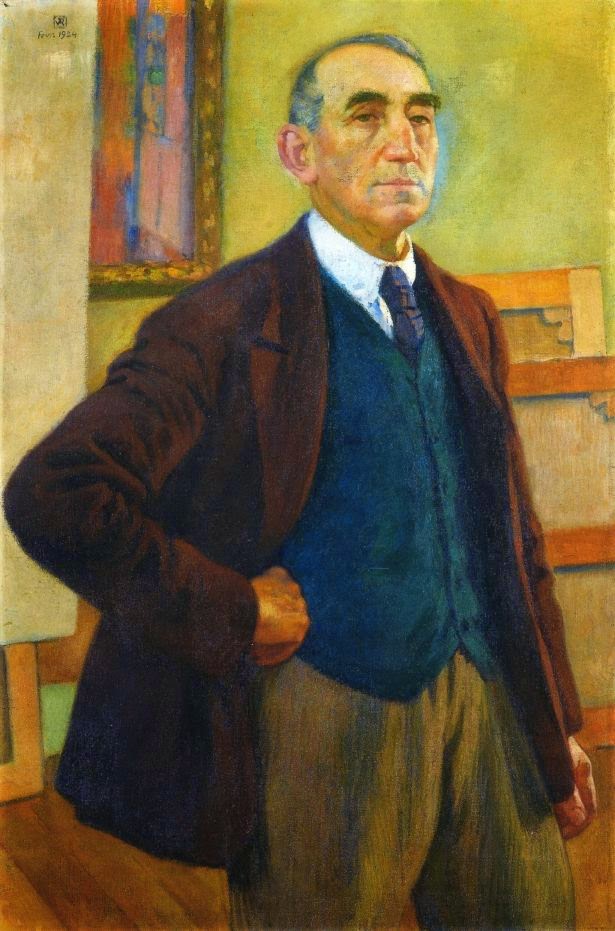
Theo van Rysselberghe, (1862-1926), Self Portrait, 1924, Oil on Canvas, 45.4 by 30.25 in., Private collection 

Theo, Portrait of Alice Sethe, 1888, Oil on Canvas, 194 by 96.5 in., Musée partemental du Prieuré, Saint-Germain-en-Laye, France

Theo, Madame Von Bodenhausen with her daughter Luli, 1910, Oil on Canvas, 46 by 37 1/8 in., Private Collection

Theo, Jeune femme en robe verte (Germaine Maréchal), Oil on Canvas, 32 1/8 by 23 7/8 in., 1893, Private Collection

Theo, La Vallee de la Sambre, 1890, Oil on Canvas, 21 1/8 by 26 1/4 in., Private Collection


Theo, Emile Verhaeren, 1915, Oil on Canvas, 30.3 by 36.2
in., Musée d'Orsay, Paris


Theo, Emile Verhaeren Writing, 1915, Oil on Canvas, 35.8 by 40 in., Private Collection

Theo, Standing Nude, 1919, Oil on Canvas , 39.4 by 25.8 in., Private Collection
Theo, Study of Female Nude
Etude de femme nue, 1913
Oil on canvas, 65.5 x 100 cm
Musée d'Orsay - See more at: http://impressionistsgallery.co.uk.s3-website-eu-west-1.amazonaws.com/artists/Artists/pqrs/Rysselberghe/07-14.html#sthash.Ld4fZKFS.dpuf
, 1913, Oil on Canvas, 25.8 by 39.4 in., Musee d"Orsay

Theo, Swimmer Resting, 1922, Oil on Canvas, 36.2 by 43.7 in., Private Collection


Theo, A Reading in the Garden, 1902


: Theo,  Paul Signac (at the helm of the Olympia), 1896, Oil on Canvas, Private Collection


Theo, Still Life with Khaki, Roses and Mimosas, Oil on Canvas, 1911

I had already saved to my trusty laptop computer a few additional images of paintings created by Theo van Rysselberghe while researching my previous blog post, so why not give this outstanding Belgian Neo-Impressionist a little more air time, says I to myself. He painted so many beautiful pictures. His paintings usually display an exquisite harmony of soft, understated color. His subjects are usually bathed in a soothing light. And his drawing and design skills were exceptional. It seems as though he never made a bad painting.

So many great paintings of his are recorded on the Internet that it’s hard to stop when you start downloading. Let’s say you admire Theo’s very entertaining and beautifully crafted painting of his friend, the Belgian Symbolist poet and writer Emile Verhaeren, showing him with his head buried in his work, his superbly drawn hands artfully posed to characterize the task of writing. The design of the canvas is a masterpiece of balance, with related elements strategically placed to take the viewer on a casual cruise around the laboring poet’s domain. Then you follow another link and up pops a full-blown portrait of the striking Verhaeren at the same desk, now with his head out of the water. This one begs for attention as well. What a dilemma van Rysselberghe poses for the lover of fine painting. Rev up your search engines and see for yourself. You won’t be disappointed.

Théo (Théophile) van Rysselberghe (1862-1926) worked expertly and comfortably in all genres and in several styles within the broad rubric of Realism, beginning with classical or academic work at the age of 18, moving on to Neo-Impressionism, then to Pointillism, the approach that earned him his lasting reputation in the world of art, and finally back to working realistically in an Impressionist manner.

Van Rysselberghe was born into an upper middle class family of architects in Ghent. He studied art at the Academy of Ghent and at the Académie Royale des Beaux-Arts in Brussels. In his formative Realist years, he spent four months in Morocco in 1882 to paint scenes from that exotic Orientalist culture. Between 1882 and 1888 he made three painting trips to Morocco. The public loved his Moroccan paintings.

In September 1883, van Rysselberghe went to Haarlem to study the light in the works of Frans Hals. “The accurate rendering of light would continue to occupy his mind” all his life, wrote an online biographer. By way of illustration, in 1918 he painted a picture of blossoming almond trees over a period of 15 consecutive days, returning to the scene at the same time each day to get the impression of light and atmosphere as close to nature as he could. The painting, Amandiers, à contre-jour (backlighting), was sold at auction by Bonhams on Feb. 4, 2014. While no doubt a fabulous painting viewed in person, its image doesn’t look great on my computer screen so I didn’t download it. Bonhams wrote that the painting of almond tree blossoms in the small village of Saint-Clair in southeastern France “proved to be the perfect setting, with the dappled sunlight filtering through the delicate blooms, to demonstrate his enduring interest in rendering light and colour.”

For some reason, van Rysselberghe had to write to Madame Lucien Pissarro to ask for permission to paint those almond trees. Maybe it was her property? It would be interesting to know why, but I’m way over budget already on this blog post. Van Rysselberghe wrote, “'I hope you would not withhold against me... if I ask for the permission to go to Saint-Clair around three o'clock, in order to have a session with my almond trees, which are finally blossoming, and for which I cannot bare to lose a day where the effect will not be more or less the same.”' The letter is quoted in Ronald Feltkamp’s 2003 catalogue raisonne on the artist.

Some 30 years before he painted those almond blossoms, the young van Rysselberghe became fascinated by the newest tendencies in European art and embraced the theories of the Neo-Impressionists. He fell under the spell of Pointillism when he saw Georges Seurat's large-scale work, A Sunday Afternoon on the Island of La Grande Jatte (1884-1886), at the eighth Impressionist exhibition in Paris in 1886.

After meeting and becoming friends with Seurat, Paul Signac and Henri-Edmond Cross, van Rysselberghe began to put those small dots of color on his own canvases. Van Rysselberghe was a better painter than the other Pointillists and a terrific portrait artist as well, which seems impossible using such disciplined brushwork. He remained faithful to his own realistic interpretation of nature through all his stylistic adventures, gradually abandoning the Pointillist technique after Seurat’s death in 1891. Despite their friendship, Signac often criticized him, thinking that Theo was only interested in commercial success when he began adapting the broadened brushstrokes of Impressionism, ostensibly to appeal to a greater public.

Theo had fully embraced Pointillism by 1889, according to his biographers. But a year earlier, at the age of 26, he painted one of the most remarkable paintings ever, a 16-foot-tall portrait of a model, using nothing but small dots of color to complete the work. I couldn’t believe the size of this painting when I asked my Internet confidant to convert centimeters to inches. I had to double-check the online conversion to see if it was correct. What a time-consuming task that must have been! I mean creating the painting, of course, not the conversion from centimeters to inches, although I was put out to have to interrupt my research to consult with my steadfast online confidant a second time.

This giant portrait of Alice Sèthe, in blue and gold, became the turning point in van Rysselberghe’s life. He went on to create scads of normal-sized portraits, figures, landscapes and still lifes in the Pointillist technique. Among his portraits were several of his wife, Marie Monnom, whom he had married in 1889, and many of their daughter Elisabeth. The Belgian symbolist painter Fernand Khnopff painted a famous portrait of Marie in 1887 that is now in the Musee d’Orsay. She was the daughter of an avant-garde Belgian publisher, Veuve Monnom (the Widow Monnom). The Widow Monnom knew many artists and writers and is described as one of many little-known female modernists in the late 19th Century.

Around the time of his marriage to Marie, Theo van Rysselberghe had a meeting with Theo Van Gogh in Paris, which led to Vincent Van Gogh’s sale of The Red Vineyard to the Belgian painter Anna Boch from an exhibition in Brussels, the only confirmed sale of one of Vincent’s paintings during his lifetime. Anna Boch participated in the Neo-Impressionist movement and was influenced by van Rysselberghe. Boch held one of the most important collections of Impressionist paintings of its time and promoted many young artists, including van Gogh, whom she admired for his talent and who was a friend of her brother Eugène Boch. Her collection was sold after her death with the stipulation that the money be used to pay for the retirement of her poor artist friends. What a lovely gesture and what a good heart she must have had. Van Rysselberghe painted an excellent three-quarter-length standing portrait of her in 1893 that is now in the Michele & Donald D’Amour Museum of Fine Arts in Springfield, Massachusetts.

After abandoning Pointillism, from about 1910 on, van Rysselberghe worked in an Impressionist manner directly from nature.  He experimented occasionally with more vibrant color combinations in some of his paintings. He also added the painting of nude female models to his dessert menu – a pleasant diversion for many celebrated male artists of yore in their mature years. And why not? Nothing is more thrilling than capturing the essence of youthful flesh on canvas, which he accomplished to perfection.

When his Pointillist years were nearing their end, Theo took a bike tour of the Mediterranean coast between Hyères and Monaco with his friend Henri Cross. Theo found an interesting spot in Saint-Clair, where his brother, the architect Octave van Rysselberghe, and Cross already resided. Octave built a residence for him there in 1911 and Theo retired to the Côte d'Azur and became more and more detached from the Brussels art scene. He died in Saint-Clair on December 14, 1926 and was buried in the cemetery of nearby Lavandou, next to the grave of Henri Cross.

Many of Van Rysselberghe’s paintings that were so enthusiastically acquired by private collectors in his lifetime have ended up on the auction block, including one of the first paintings of his that won my heart, his enchanting portrait of Madame Von Bodenhausen with her daughter Luli, which he painted in 1910. One of Madame’s children was cut out of this portrait for some reason that eluded me in my Internet research. Sotheby’s writes that Luli grew up to be a great beauty and star, using the stage name Luli Deste after she moved to Hollywood. She starred in a number of movies, including Thunder in the City with Edward G. Robinson in 1937. I haven’t seen the movie. I’m sure Sotheby’s is right and I have no desire to look further into Luli’s Hollywood career. Painting pictures is more than enough cinema for me these days. At any rate, this gorgeous painting of mother and child sold at Sotheby's London on Feb. 4 of this year for a mere $28,436, after failing to sell at a previous auction.

Meanwhile van Rysselberghe’s Pointillist portrait of a rather glum-looking Germaine Maréchal, titled Jeune femme en Robe Verte, which he painted in 1893, had sold for $1,223,108 just five years earlier, on Feb. 2, 2010 at Christie’s London. Did Theo’s stock decline so rapidly in the art world in just five years? Or did Christie’s simply have a better salesman on the case? Maybe it’s because the portrait of Germaine is such a perfect example of his Pointillist phase. Maybe it’s because one of Madame’s children was lopped off in that portrait. As usual, I’m clueless. It’s easy to put a price on a painting, but it’s impossible to know for certain what it's worth in the marketplace.  I know that for certain.

Wednesday, May 6, 2015

Theo and Marguerite


Theo van Rysselberghe (1862-1926), Marguerite van Mons (1876-1919), 1886, Oil on Canvas, 35.2 by 27.8 in., Museum of Fine Arts, Ghent, Belgium

Marguerite van Mons, Detail

Camille van Mons, 1886, Oil on Canvas, 35 by 27.5 in., Niedersächsisches Landesmuseum, Hannover, Germany
Wouldn’t it be nice to live in a place and at a time when you could concentrate all your efforts on painting a memorable picture full of pure and transcendent human emotion without worrying about achieving photographic “accuracy” from the get-go? Such a place was Brussels, Belgium.  The year was 1886.  The month was June.

That’s where and that’s when the brilliantly gifted Belgian painter Theo van Rysselberghe, only 23 years old at the time, painted his remarkable portrait of Marguerite van Mons, who was 10 years old when she stood for the artist at her home in front of a huge double door painted a lovely pastel blue and embellished with gilt moldings.

Marguerite is dressed simply in the type of long-sleeved black costume that would be a delight to paint. It’s quite thrilling, actually, when you finally get to the point in your painting when you are ready to boldly accent all that black with a deeper shade of black, as with the wide belt in this case.  The only other accent is the silver bracelet gleaming on her wrist as she grasps the handle of the door –a fascinating idea for a pose.  Had she expressed a normal child’s desire not to be painted at all and therefore was depicted by the artist as someone anxious to leave? 

The gilt ornamentation on the door is painted exquisitely by the young painter, with enough detail to be convincing, but not too much to detract from his sensitive portrayal of the elfin Marguerite.  Theo’s treatment of Marguerite’s expressive face, with that slightly open mouth and dreamy, thought-provoking gaze, can seem so incomplete to all contemporary painters who choose to rattle the chains of photographic realism.  But it’s perfect.  

Conveying human emotion on canvas goes far beyond the known world of technical rendering to an uncharted realm of deep concentration shared by the painter and the sitter for only a few brief hours.  But the resulting portrait has the potential to carry on this fleeting encounter through the ages -- a testament to life eternal.  Painting is truly a gift from heaven.

Theo also painted a superb portrait of Marguerite’s older sister, Camille, although he placed her in a conventional pose and created a naturalistic portrait.  The result is far less intriguing.  For whatever reason, Marguerite’s personality and demeanor must have suggested a more daring and provocative treatment for her portrait. Theo dedicated his captivating portrait of Marguerite to Emile van Mons, the father of the two girls.  Van Mons, a lawyer and renowned patron of the arts, was a good friend of the precocious painter. 

Now let’s take a minute to discuss Marguerite’s extended arm.  I can just imagine a less sophisticated parent loudly complain, “But, monsieur, you have made the arm far too long!”  Because the portrait in toto is so mesmerizing, this is not something that the average person would even notice, unless you stare at it like an idiot and try to take measurements off the computer screen to see if it is indeed so.  Who would do a dumb thing like that, I wonder.  And after reconsidering my review of this painting in the cool light of the morning after, I am beginning to see several little "imperfections" in the portrait of Marguerite -- the kind of petty details involving measuring that drive me crazy in my own work.  Painters of the past often got by with anatomical murder to produce their masterpieces.  Try it today and they will shoot you at sunrise.

A fascistic demand for photographic “accuracy” permeates the traditional art world today, dear friends, and that’s the main reason nobody paints a really memorable portrait anymore.  You can’t make the arm too long or give summary treatment to the likeness these days.  And if you realize you have done so in moments of passionate painting and are compelled to correct your "mistakes," you can kiss your masterpiece goodbye!

But what’s that you say, “That was then and this is now?”  Of course, you’re right.  I was being judgmental again.  I apologize.

Wednesday, April 29, 2015

Remembering Leopold Seyffert


Leopold Seyffert (1887-1956), In My Studio, 1931, Oil on Canvas, 60 1/2 by 54 1/4 in. , Smithsonian American Art Museum, Washington, D.C.


Duane Van Vechten, 1924, Oil on Canvas, 50 by 40 in., Private Collection.  Ms. Vechten was the daughter of wealthy banker Ralph Van Vechten.  She was an early member of the Taos, New Mexico artists’ colony and a patron of artists.


Nicolai Fechin (1881-1955), Duane Van Vechten, 1926, Oil on Canvas, 50 by 40 in., private collection.  Painted two years later.  What a contrast.  Both great portraits.
Samuel Gompers (1850-1924), 1919, Oil on Canvas, 47 by 38 in., New York Historical Society 


My Family, 1928. Oil on canvas, 76 3/4 x 51 1/2 in. Brooklyn Museum.  Painted in their Paris apartment.  Left to right, Helen Fleck Seyffert (1891-1951), and sons Peter (1917-2003) and Richard Leopold (1915-1979).  Richard would later become a portraitist like his father.


Katherine Abbott Bigelow, 1932, Oil on Canvas, 30 by 25 in., Private Collection


Bobby, Oil on Canvas


Daniel Zuloaga (a Spanish ceramist and Ignacio Zuloaga’s uncle), Oil on Canvas


The Lacquer Screen, 1917, Oil on canvas, 54 3/16 by 60 in., Acquired 1918 by Pennsylvania Academy of the Fine Arts


It’s thrilling to view the work of painters from the past who had a keen eye for the nuances of brilliant color and could draw swiftly, accurately and decisively with a fully loaded brush in such a way that their subjects are brimming with life on canvas.

Leopold Gould Seyffert (1887-1956) had that rare combination of skills, as evidenced by a number of outstanding paintings he produced early in his career.  That gift is not so evident later on when he was busy cranking out excellent but unremarkable commissioned portraits in competition with many other highly accomplished portrait painters plying the trade in the first half of the 20th Century.  Seyffert was one of the most successful of all of them, and yet he remains one of the most unrecognized by the general art public.  He painted over 500 commissioned portraits in a 49-year career, sometimes as many as 25 a year – an incredible feat.  His subjects included such notables as Henry Clay Frick, Fritz Kreisler, Leopold Stokowski, Andrew Mellon, Samuel H. Kress, Elizabeth Arden, Samuel Gompers, Charles Lindbergh, David Sarnoff and members of the Du Pont family. 

He also painted a portrait of the famous “Golden Age” contralto Louise Homer, which is on view in the gallery of opera stars on the first level of the Metropolitan Opera House at Lincoln Center.  I coincidentally paid more attention to this painting Monday night while attending the Met’s performance of Lehar’s The Merry Widow.  The Homer portrait shows that, even as good as Seyffert was, he didn’t hit a home run every time at bat when doing commissioned portraits.  But given his talent and the fact he was much in demand, he must have had a pretty good batting average.  And I might as well add that most of the portraits of the fabulous, world-famous opera singers in the Met gallery aren’t very good.  A lot of them, in fact, are mediocre jobs that look like they were done from publicity photos.  I could say more, but I’ll just bite my tongue.

Seyffert’s relative obscurity is not unusual for sought-after painters of commissioned portraits when their time on earth has ended.  After the painting is unveiled and hung on the boardroom wall or above the fireplace in a stately mansion, chances are you won’t hear about the painting or the painter again, that is until the corporation decides to deaccession its art collection or the heirs get tired of looking at Grandma hanging on the wall and put her up for auction.

Before he really got down to business with his commissioned portraits, Seyffert created a number of nude figure paintings from 1916 to 1922 that “were so well received when they were exhibited throughout the country that they were usually immediately acquired for major museums,” according to a blurb on the website of the Los Angeles County Museum of Art (LACMA).

He also drew charcoal portraits ala Sargent and painted landscapes, floral still lifes and a few excellent self-portraits.  I was blown away when I first came across his brilliant, creamy 1931 self-portrait “In My Studio” while doing a little Internet research a while back on Ignacio Zuloaga, one of my favorite painters.  Seyffert had studied briefly with Zuloaga in Spain in 1914, after studying at the Pennsylvania Academy of the Fine Arts from 1906 until 1913 with Thomas Pollock Anschutz, William Merritt Chase, Cecilia Beaux and Hugh H. Breckenridge.  I’m guessing that Zuloaga’s paintings of nudes inspired Seyffert to create a similar body of work.  And it looks like he took quite naturally to the fluid brushwork of Chase and Beaux for his own smooth yet vigorous paint handling technique. 

The aforementioned In My Studio is such a perfect example of what can be accomplished with oil paint if one has self-confidence and a complete mastery of the craft.  If you look closely at the base of Seyffert’s neck, for example, you can see, even in reproduction, how gorgeous that patch of flesh painting is, with fluid strokes of beautiful color showing just enough anatomy to be totally convincing as the real thing. Try it yourself and you are bound to fail.  Such a passage has to be painted boldly with broad strokes from a big brush fully loaded with juicy paint, and perhaps a little blending with a soft brush at the end to get that seamless unity of skin tones.   I’m just speculating, you understand.  I didn’t see how he did it.  And that’s always the great mystery with beautiful painting – how was it accomplished?  All we can do is guess.  Don’t let anyone suggest otherwise.

Before the portrait commissions started pouring in, Seyffert played semi-professional baseball, as did his contemporary, George Bellows.  A lot of the bravura painters from those days were macho men who excelled at some athletic activity before settling on the greatest sport of all, alla prima oil painting.  To be really good at it, you have to be physically fit and under 60 years of age, give or take a few years.  You get quite a workout dashing back and forth in front of your easel to get a living, breathing portrait painted life-size in one sitting.  Today’s artists who insist on working from life photographically on a painting for weeks on end, putting every close-up detail on an emotionless face, should be sentenced to six months in an alla prima boot camp to learn how to get some life in their paintings.  I can’t imagine the proper punishment for those enormously successful portrait “painters” who copy beautiful photographs so perfectly that you can’t tell the difference.  Maybe just a worldwide ban on such despicable acts.

Seyffert was born in California, Missouri, in 1887, the sixth of seven children of Hermann and Emma Tweihaus Seyffert.  The family soon moved to Colorado Springs, Colorado.  In 1890, his German immigrant father, a contractor, fell off a roof and died, leaving the family members “to work or marry early.”  I assume Leopold was no longer a toddler when he painted cakes at a local bakery and glass eyes for a taxidermist.  Following an older brother to Pittsburgh in 1904, Seyffert worked as an office boy for John Worthington, a Standard Oil geologist who loaned him money to attend the Pennsylvania Academy of Art.  Seyffert painted portraits of Worthington family members to repay the debt.

You can read a lot about Seyffert’s life and painting career on the Internet, including an extensive biographical entry on Wikipedia.  Much of this information comes from Robert Seyffert, Leopold's grandson and a painter himself, who is trying his best to get his exceptionally talented grandfather back in the limelight.  Most recently, Robert arranged a showing of Leopold’s work early this year at the Union League Club, a private social club in New York City.  Unfortunately I didn’t get to the show.  I’m missing out on everything these days.  Holy creeping inertia!

Seyffert made three trips to Europe as a young man – in 1910, 1912 and 1914, copying from Velazquez at the Prado, admiring the work of Hals and painting the locals when he could, including peasants in Vollendam, Holland.  He went on that first trip to Europe in 1910 with his fiancée, Helen Fleck, also an artist, and her mother.  Leopold and Helen were married in 1911.  They resided in Paris off and on for some years, hobnobbing with quite a few members of the cultural and social elite, including Zuloaga, Stokowski, Hemingway and Man Ray. The couple had three children, a girl and two boys.  One of the boys, Richard Leopold, became a portrait painter himself and taught at my alma mater, The Art Students League of New York, as his father had done years before. 

Leopold and Helen divorced in 1930 and he married Grace “Bobby” Vernon, who for over 15 years had modeled for many of those nude figure paintings of his that were such big hits with collectors.  That phase of Seyffert’s career is the subject of a brief essay on LACMA’s website regarding one of Seyffert’s nude figure paintings in its collection.  Here is an excerpt:

“The most modernist works Seyffert was ever to produce, these canvases were no doubt influenced by the nude studies painted by his friend Arthur B. Carles. Both men used the same model, beautiful red-haired Grace Vernon, better known as ‘Bobby’, who would later become Seyffert’s second wife. In several paintings Seyffert placed Bobby in highly decorative interiors with an ornate oriental screen, panel, or drape as a backdrop. Her body was treated as a single form and her extremities generalized or attenuated. In The Lacquer Screen, 1918 (Pennsylvania Academy of the Fine Arts, Philadelphia), the curves of the nude echo the calligraphic lines in the Chinese coromandel screen behind her…”

In my opinion, Seyffert’s nudes also owe a debt to Zuloaga, who used boldly patterned and lushly painted draperies to dramatize the nude figure in paintings he was creating in Spain around the same time.  But Zuloaga’s nudes are actually bold portraits of his unclothed subjects, in contrast to the stylized nudes created by Seyffert and Carles. 

It is said that Seyffert eventually ruined his health from smoking and drinking, but he continued painting commissioned portraits until near the end of his life. When Bobby died in 1950, a new model and companion, Ramona, took care of him until he died of esophageal cancer in 1956, in his 69th year.  Ah, yes, artists and their models once again.  I’m tickled to add another footnote to the old, old tale.  And being primarily a still life painter myself, a little envious, as well.

Sunday, April 19, 2015

Three Little Words


Peonies in Tequila Bottle, Oil on Panel, 14 by 11 in., https://www.etsy.com/shop/RobertHoldenFineArt

Amaryllis and Tall Chinese Vase, Oil on Canvas, 30 by 24 in.,  https://www.etsy.com/shop/RobertHoldenFineArt

Three Rustic Potteries, Oil on Canvas, 24 by 30 in., https://www.etsy.com/shop/RobertHoldenFineArt
Unlike most bloggers who write about painting, drawing and related subjects, some on an incredible daily basis, I don’t like to clog the digital airwaves until I have something really important to write about.  This, however, is not one of those rare occasions.  It’s just a little nudge to get my minimally functioning brain off standby mode.  Sort of an “I blog therefore I am” thing.

I wish I could control myself and write blog posts without mentioning any famous names or popular subjects so nobody would ever read them but me, myself and I (ignore grammar check).  By the way, my minimally functioning grammar check program nearly always rejects any use of the pronoun “myself,” as it just did.  In this instance, it wants me to write, “Me (capitalized), me and I.”  What’s up with that, grammar check?  Whose side are you on?  Not the side of myself, obviously.  Oh, so that one is OK?  Why not tell me to recast the sentence to “Not my side, obviously.”  Go figure.   This has been a test of grammar check.  Regular programming will resume shortly, I’m sorry to say (ignore grammar check, wants to replace “to say” with “saying”).

I am well aware of the fact that the merest mention of “so and so” or “this, that and the other” means I am sure to be visited briefly by Internet surfers with particular interests within the aforementioned categories.  They no doubt savagely hit “close” as soon as it is apparent that the blog post they have chanced upon is pure drivel.  Google should identify and reward with a medal of valor those few visitors among the aggregate 20,000-plus who have had the temerity to read all the way to the end of even one of my posts.  Having such a justifiably low opinion of the value of my musings, I perforce shrink from engaging in any dialogue with Internet surfers or unsolicited social network acquaintances because I’m not man enough to handle the stress of rebuke or, even worse, praise.  Who wants to know what other people think about your opinions or writing style?  Not me!  “Then just keep a handwritten diary in a dresser drawer and don’t waste precious space on the Internet bothering the rest of us with your juvenile prattle,” would be an appropriate retort from the teeming masses drawn inexorably and unwittingly to the edge of the abyss of Internet inclusion.  Huh?!

Nevertheless, I throw caution to the wind and return to another glorious episode in my action-packed life – a week spent on vacation in a little town in Pennsylvania Dutch country, which will remain nameless to protect the innocent, i.e., me, myself and I.  It was pre-ATM America when I left New York City years ago, with very little money in my pocket, no credit card, no car at my disposal and a plan to do some plein air painting. It almost killed me.  

I had viewed the opportunity to house-sit for a week in this town as a low-cost way to get out of New York City in August, just like psychiatrists and other normal New Yorkers.  I took my half-size French easel with me and was excited to see the lovely countryside from the windows of the regional bus on the way to this little town.  But the house I stayed at was a very long walk away from nature’s realm.  I ventured to take that walk my second day in town, but at the end of the road I was confronted by a vast and impenetrable cornfield.  So I trekked back to the house and never did any plein air painting the entire week, occasionally muttering the dejected landscape painter’s refrain, “If I only had a car!”

Walking on the sidewalks of this little town to get to Main Street meant the stranger that was me had to walk past quite a few private homes.  Nobody else was walking anyplace in the neighborhood and I could sense the curtains being drawn aside as I sauntered slowly by, smelling the roses on the way.  I hadn’t been out of New York City for awhile, so this was an unsettling experience, and another reminder of how necessary the automobile is in America’s small towns.  An unexpected pleasure of my vacation was discovering that the house I stayed at was ideally situated directly across from the high school football field, so there was plenty of pre-season practice noise to disturb the peace.

I mostly sat in the house in the evening watching television.  I don’t own a television, so I spent many hours fiddling with the remote control to check out the hundreds of cable channels the homeowner subscribed to.  I took a couple of side trips by bus during the day to the closest big towns of Reading and Allentown to explore the shops on their main streets.  I don’t remember much about those trips, other than having the elderly owner of an antiques store tell me how he stopped an embolism from moving up his left arm by pounding it back down into submission.  I still keep his excellent First Aid advice in mind should the need arise.

The family of a friend who arranged my stay lived in a neighboring town, and I was picked up to have dinner with them a couple of times.  Cousins of theirs had a vineyard nearby.  Visiting it and sampling some of the wines on Saturday was perhaps the highlight of my vacation, although I really can’t say for sure.  Hitting the TV remote was pretty thrilling, too.  I think Club Med is considering this little town for a change of pace vacation spot.  But maybe it was just me.  Someone with a more positive outlook would probably have the time of their life in this little town --  if they have a car to get around.

There were no Chinese take-out places within walking distance, so eating was a major problem during my week-long retreat, because preparing meals is not in my DNA.  I didn’t have enough cash with me to eat out at restaurants and I didn’t want to destroy the homeowner’s kitchen, so I ended up eating mostly red grapes, crackers and cheese, with disastrous results.  I lost a few pounds on this diet during my vacation.  When I bid a fond farewell to my little town buried deep in the bucolic Pennsylvania Dutch countryside  and took the bus back to New York City, heaving a great sigh of relief, let me tell you, I immediately resumed my normal diet, which at the time consisted of pizza for lunch and lots of beans and rice for dinner.  The result was a stomach explosion that set off a month of dramatic weight loss and an intense fear that I was going to die soon.  I bicycled like mad early in the mornings on the bike path along the Hudson River to ward off the demons of insanity.  The VA Hospital took tests and said I wouldn’t die just yet.  And so I didn’t. 

Consequently, I am able to proclaim today, many years later, that the three words in the English language that best illustrate the abysmal state of affairs for most traditional realist painters in America are “Call for Entries.” I myself quickly cross out all the items with those huckster words and their attendant, non-refundable entry fees listed under “Opportunities” in the art publications.  When I’m done, I am left with absolutely no opportunities to show my work!  Guess I’ll just have to be satisfied with selling it once in awhile.