Wednesday, July 2, 2014

Becoming an Artist, Virtually


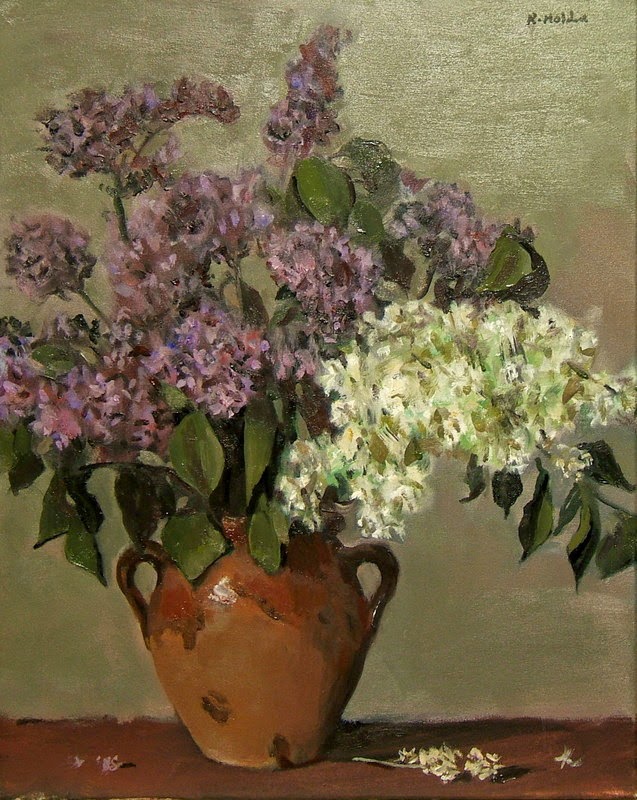
Ginger, the Cat, doesn't pay much attention to my paintings

Well, I couldn’t stand it any longer, so I just signed on with Etsy to become a virtual artist with a virtual gallery and a virtually unlimited worldwide viewing audience for my paintings.  The idea of Etsy is very intriguing.  Trying to get into a real gallery in New York City, or anyplace else, for that matter, is almost impossible, given the incredible number of “emerging” artists prowling around these days with their digital portfolios full of images of pretty darn good paintings.  The art world is full of what Noel Coward said about the stage, “implacable ambition.”

And I know that at my advanced age I will never acquire an idyllic storefront gallery in some quaint tourist town where I can sit all day and wait for the occasional unsuspecting tourist to drop in to admire my paintings and walk out without buying a single one of them.  I think I would really love that kind of life.  I had paintings for a long time in a Soho gallery that was operated along those lines.  If people bought the paintings the owner liked well enough to display, that was fine.  If they didn’t buy them, that was fine also.

Etsy makes it very easy for any artist to set up a virtual storefront gallery with the potential for unlimited virtual tourists to drop in unannounced.  Maybe they won’t buy anything either, and I have some concern that not all visitors to the online marketing sites are square shooters.  But at least my paintings will most likely be seen by someone other than me and Ginger, the cat, who doesn’t pay much attention to them, unless she can scratch her chin against the edge of the canvas.  And who knows, maybe I actually will do a little shipping and handling in the real world because of Etsy.  That would be very nice.  I need to make room for all the new paintings I plan to keep making, the Good Lord willing and the Creek don’t rise, as they used to say when the world was a kinder, gentler place, at least if you didn’t think too hard about anything, the fish were biting and you always rooted for the home team.  

I really don’t have much to say at this time about my new adventure.  I’ve always hated to talk about my paintings with all the people who know me, in the non-biblical sense of knowing, of course.  But in the vast world of the Internet, somehow it doesn’t seem such a hard thing to do – talk about my paintings, that is.  I’ve often longed to tell people about how I acquired a particular object to put in a still life, and all the struggles I went through to get a reasonable facsimile of the things I was painting.  I can see myself blathering on interminably about the most mundane of my paintings.  Dealing with strangers is always more satisfying than dealing with people you know.  When I worked at the Information Desk at the Metropolitan Museum of Art, my young colleagues would time me out at around 20 minutes as I talked about the museum’s glories with polite visitors whose main interest was finding the nearest bathroom ASAP. 

I’m mildly excited about this new venue for showing my paintings, and invite anybody who might have read down this far to take a look at my Etsy site.  Here’s the link:  https://www.etsy.com/shop/RobertHoldenFineArt.   I’ll try to write something less self-serving in my next post – maybe something about “hearing voices” when I paint.  Nothing strange about that for an artist.

Sunday, June 15, 2014

A Museum Director


Jose Villegas y Cordero, The Slipper Merchant, 1872, Oil on Canvas, 19 x 25.6 in., The Walters Art Museum, Baltimore

Jose Villegas, Ladies in a Garden, Oil on Canvas, 16.93 x 22.83 in., Private Collection

Jose Villegas, The Tennis Player (Pablo Ramos Villegas, the Artist’s nephew), 1905, Oil on Canvas, 74 ¾ x 35 ½ in., Private Collection   
Most directors of major museums today have art history backgrounds, but when great European museums such as The Louvre, The Prado, The National Gallery and The Tate were getting started, painters ran the show.

Jose Villegas y Cordero (1844-1921), for example, was a very accomplished painter who served as Director of The Prado from 1901 to 1918.  He had a fine sense of color and could draw extremely well, thanks to rigorous academic training.

Villegas y Cordero began his studies in his early teens at the School of Fine Arts in his native Seville.  When he was 23, a patron sent him off to Madrid to study with Federico Madrazo, a member of the illustrious Madrazo family of painters.  Many years later, Villegas was to follow his mentor as Director of The Prado.  Federico, in turn, had succeeded his father, Jose de Madrazo y Agudo, who served as Director of the Prado from 1838 to 1851.  I’m getting unjustly sidetracked here by associated data, but the Madrazo family also includes Federico’s son, Raimundo de Madrazo y Garreta (1841–1920), the most well-known of the formidable Spanish painting clan and one of my favorite painters.

In Madrid, Villegas made frequent trips to The Prado to copy Velazquez, whose work inspired him to develop a loose and spontaneous manner of painting, according to his biographers.  Villegas also admired the exuberant brushwork and Orientalist works of another teacher, Mariano Fortuny y Marsal (1838-1874).  Villegas went on sketching trips to Morocco to gather material for his own Orientalist paintings.  For a number of years, he had a very successful career in Rome and Venice, painting Orientalist, History and Italian Renaissance themes.  In Rome, Villegas inherited the mantle of Fortuny, who died in Rome from a malarial fever he contracted while plein air painting in the summer of his 36th and last year of life.  By the way, Fortuny was married to Federico Madrazo’s daughter, Cecilia, in case you didn’t know.  There was a lot of social networking among painters in the 19th Century. 

One of Villegas’ Orientalist paintings online is The Slipper Merchant, which is in the collection of The Walters Art Museum in Baltimore.  The Museum has this to say about the painting:  “In the dimly lit, richly colored interior of a North African shop, a turbaned merchant serves a customer seated on a divan. Kneeling in front is an attendant, and barely discernible in the background is a craftsman at work. To the left, a man smokes a hookah. Villegas has adopted a subject made popular by Mariano Fortuny, but rather than exploring light effects, he provides an almost overwhelmingly detailed array of bric-a-brac. Even the picture frame, custom-ordered for this painting, is inscribed in Naskh script: "There is no God but Allah and Mohammed is his Prophet."

Near the end of his very successful career in Rome, Villegas was named Director of the Spanish Academy of Fine Arts in Rome.  Two years later he left for Madrid to become Director of The Prado.

I wonder what the museums would be like today if painters still called the shots, rather than medieval tapestry scholars and the like, who have to behave like high-end carnival barkers to pull in the crowds.  All the old painters I’ve met remember the halcyon days when they had the painting galleries all to themselves whenever they visited the Metropolitan Museum of Art.  Wouldn’t it be nice to return to those golden days of yore?  Fighting through hoards of bewildered, bored and bellicose tourists is pure torture for any lover of painting.

Mario Fortuny, The Odalisque, 1861, Oil on Cardboard, 22.4 x 31.9 in., Museu Nacional d’Art de Catalunya, Barcelona

Raimundo de Madrazo y Garreta (1841-1920), Fond Memories, Oil on Canvas, 32 x  36 in., Private Collection

Monday, June 9, 2014

What if I am?


The BBC had a long-running television show called “The Good Old Days,” which recreated the spirit and look of the British music hall of the “Gay 90’s,” to the extent of having the members of the audience dress up in period costumes and sing along to some of the tunes.  The show ran from 1953 to 1983.  I had never seen it until somebody uploaded a bunch of highlights onto YouTube a couple of years ago.

One of the acts was a little guy wearing a snappy red bandleader outfit, with a big bass drum strapped to his back and cymbals fixed on top of his head.  He performed a frantically comic version of “McNamara’s Band.”  When he first pranced onto the stage in this ridiculous getup, he stopped, looked squarely at the audience and, with a scowl on his face, declared, “What if I am?” in a defensive tone.  He got a big laugh.

“What if I am” is a neat phrase that has been sneaking into my thoughts lately.  It would make a good title for a motivational self-help book with a confrontational bite to it.  You might also say, “I’m doing my own thing and what’s it to you.”  Might be a best-seller on Amazon.
.
Not that it matters to anybody else, of course, but that’s kind of how I’ve conducted my negligible painting career for many years.  I have no interest in following the crowd to make a buck.  I have absolutely no burning desire to blaze new ground with my painting.  The things I like to paint are simply the beautiful things painters have always painted from life. Accurately recording any old scene from contemporary life, like strip malls with lots of utility poles, traffic lights, signage and parked cars in them, or village intersections with lots of utility poles, traffic lights, signage and parked cars in them, or urban environments with lots of utility poles, traffic lights, signage and cars in them, as former advertising illustrators and graphic designers are good at doing, is not for me.  Snapshots tell you all you want to know about such scenes.  We are advised to paint 24/7 and not wait for inspiration.  But it seems to me there’s no point to painting, or engaging in any creative art, for that matter, if you are not inspired.  We’re not digging ditches here.  I’m not supposed to be inspired to paint?  How is that possible?   My inspiration comes from looking at nature and looking at beautiful paintings.  Pretty original, huh?  That’s all there is to that, and really all that I can say about my own painting.  You look, you like, you don’t like.   

Painters are initially attracted to painting and other forms of art because we love creating it.  Millions of deadbeat Americans like me now call their passion their profession these days, even though many of my comrades at easel have waited to take up painting until the kids are grown or they have retired from another career.  This late start in the brush-cleaning routine makes them easy prey for the bottom-feeding artists who figure out ways to profit off that passion.  These profiteers are in high gear now that warm weather has arrived in the Northern Hemisphere.

I have to say I’m a devout curmudgeon concerning the art business.  What if I am?  I’ve been paying attention to all the art marketing magazines for years and haven’t seen fit to embrace any equally satisfying alternative attitude.   Of course, I could just smile and try to take advantage myself of all the marketing opportunities available for artists, but I’ve got far too much integrity to sell art like life insurance or encyclopedias door-to-door.  A Lutheran life insurance salesman knocked on our door in my little home town when I was 12 years old and sold me and my brother $1,000 life insurance policies, something every child should have, considering the potential disasters lying in wait when puberty strikes.  You never know what can happen to you, after all.  He opined flatteringly that I would make an excellent man of the cloth, so of course he got the cash from this youngster of integrity and I got that valuable Lutheran life insurance policy.  It expired in a year, and I’ve resisted all temptation to purchase another policy from the various purveyors, praise the Lord.  But then I’ve never met another Lutheran life insurance salesman, either.  And now AARP won’t leave me alone.

I recently looked into an online gallery that wants to attract “emerging and mid-career” artists with “a positive attitude.”  That leaves us me out.  Who wants to promote the work of a curmudgeonly artist well past mid-career? 

Right now there is a mountainous flurry of happy painting experiences waiting round the bend, as artists traipse hither and yon to pick the pockets of millions of other artists through useless enterprises such as vanity workshops, plein air painting excursions, conventions, instructional books and videos, pay-to-watch demos, and much more. 

But everybody seems to have a jolly good time spending their money on these communal endeavors.   Somebody is hosting a week-long workshop in the fall at a Happy Trails ranch miles from nowhere in sagebrush country.  Dinner at the bunkhouse is $60 bucks, and McDonald’s takeout is probably not an option.   I don’t know any artists in New York City who can afford such extravagances.  Of course, I don’t know many artists.  But somebody else is probably paying the bill for most of those who attend these art-related social events anyway. 

Then there are the handyman artists who produce unnecessary custom art supplies like pochade boxes, pre-primed art panels,  giant double-mast easels for your 8 by 10 foot studio with low ceilings, and exclusive brands of oil paints “without fillers” to satisfy the voracious appetites of profligate artists and the credit card companies. 

Whenever I see the phrase, “call for entries” in the art magazines, I want to scream.  Many artists do answer the call, but few are chosen.  Why should I pay an entry fee of $40 bucks for juried exhibitions and risk getting rejected so you and your friends can socialize on a regular basis at swell receptions for the chosen few, most of whom are members of the sponsoring art club?  And I just saw that an art supply manufacturer is sponsoring a contest with a $40 entry fee.  Most of the prizes are this company’s own art supplies, which I never use.

None of this nonsense is necessary for you painters out there, and it will only confuse you anyway.  Continue your “home schooling” after your studies and paint whatever you like that is extremely convenient and comfortable for you to paint.  Never walk more than a few blocks from your studio to find your subject matter.  Paint only by natural light, even when it is overcast to the point of being nearly unable to see your subject matter.   Don’t spend more than $6 or $7 for a small tube of paint, no matter what the color is.  Buy the big tubes of brands your rich friends turn up their noses at.  Avoid juried shows like the plague.  Paint your subjects in the way you alone are capable of painting them at the time of their execution.  And unless you are a mad genius, I can guarantee that you will end up an alienated “starving artist” just like me.  Ah, yes, “What if I am?”
 

Monday, June 2, 2014

Sir Thomas Takes Advice


Thomas Lawrence, Elizabeth Jennings, 1799, Oil on Canvas, 50 by 40 in., Private Collection

Thomas Lawrence, The Calmady Children, 1823, Oil on Canvas, 30 7/8 x 30 1/8 in., Metropolitan Museum of Art

Thomas Lawrence, Lady Maria Conyngham, 1824-25, Oil on Canvas, 36 ¼ by 28 ¼ in., Metropolitan Museum of Art
I may have mentioned this before, but I hate having people try to tell me how to paint or what to paint.  When I began painting in oils more than 30 years ago, I felt that at last I had found something in my life that I loved doing and had some control over, and I don’t want anybody else giving me advice on how to “improve” my paintings.  They are my creations and they are what they are, for better or for worse.  I think most painters feel as I do, even though we are not talented enough to produce masterpieces and will likely remain anonymous and irrelevant in the grand scheme of things. 
 
If Sir Thomas Lawrence P.R.A. (1769-1830) had felt the same way about taking advice, you might not have heard of him either.  Sir Thomas is one of the greatest of all the many wonderful portrait painters working in the British Isles from the 17th to the early 20th Centuries, capturing on canvas the characteristic fair complexion of the natives, which takes the light so well, is lovely to look at and ideal for replicating in oil paint with copious amounts of white paint and touches of red and yellow ochre. 

Portrait painting became the preeminent art form in that once-mighty kingdom after Anthony Van Dyck settled in London in 1632.  Somebody once said Van Dyck showed the English portrait painters how to paint their countrymen.  Somebody also said that portraiture has been in decline ever since his death.  And somebody else likened the thought that Van Dyck might have retouched anything on a portrait head, after his rapid painting in one sitting into a tacky surface, to be rather like “spitting in church.”  One look at a Van Dyck portrait and you agree with them.
Anthony Van Dyck (1599-1641), Cornelius Van der Geest, 1620, Oil on Panel, 37.5 by 32.5 cm, National Gallery, London
Lawrence succeeded Reynolds and Gainsborough in carrying on the tradition of portraiture in the grand manner established by Van Dyck.   He was something of a child prodigy with his gift for getting a likeness.  When he was around six years old he began helping his hapless innkeeper father pay the bills by either reciting poetry or drawing profile portraits.  As a young man, he learned how to handle oil paint with a brush better than most other painters of his day.  This enviable virtuosic facility, coupled with his god-given talent for capturing the spirit of life in his sitter’s faces, propelled Lawrence to fame as Europe’s premier portrait painter.  And if you love looking at outstanding portraiture, you have to smile when viewing Lawrence’s delightful depictions of animated young female faces.  His Royal Academy colleagues recognized his genius by electing him their President, succeeding Benjamin West.

But Lawrence was primarily self-taught, which is a fatal defect in lesser artists who aspire to paint from life in a traditional manner.  He skipped the cast drawings during his brief stay at the Royal Academy to concentrate on his commissioned portrait work.  Maybe that explains why I’ve always felt his full-length compositions and drawing of the sitter’s extremities do not match the quality of his “headshots.”  The voluminous, body-concealing fashions of the day were a great help to Sir Thomas and his fellow portrait painters because they could fill their large canvases decoratively and avoid grappling with uncompromising anatomical accuracy.

Perhaps this lack of academic training is the reason Lawrence apparently didn’t mind receiving critical advice when he was working on a major full-length portrait, unlike most painters today who bridle at the merest hint that their photographic confections might not be picture perfect. 

When painting his 1799 portrait of Elizabeth Jennings, for example, Lawrence, who was 30 years old at the time, took so much advice from his close friend Joseph Farington, a landscape painter and noted diarist, that he should have been ashamed of himself.  Farington did everything but paint the picture for him, it seems.  All the sordid details can be found in the catalog for Christie’s auction of British and Irish art in London on Nov. 11, 1999.  Christie’s transcribed Farington’s diary entry of March 17, 1799, in which he recounts all the advice he gave Lawrence regarding this portrait.  I found Farington’s account fascinating and somewhat surprising, considering the high regard I’ve always had for Sir Thomas.  I’ve done a tiny bit of cosmetic editing of Farington’s diary entry to make the sentences less choppy and a little easier to read.

Elizabeth Jennings was celebrated for her beauty, Christie’s tells us in its painstaking research into this portrait.  Farington said “the beautiful Miss Jennings” had no serious competition in London’s social whirl “during two or three seasons successively.”  He was eager to follow the progress of her portrait in Lawrence’s studio and discussed the portrait over breakfast with Lawrence when it was nearly complete.

Farington writes, “I told him that it was a picture of a higher order than any female portrait I had seen of his painting -- more sober and solid, and free from flickering lights.  The principal defect appeared to me to be that the arms did not appear to be of the same flesh as the face and neck, but too cold and purply, and that the light sash which was thrown round the waist and arms was too much of the same colour with that of the skin, the whole too pinky. He admitted readily the truth of the remark. I said there wanted an opposition -- a change of colour to give value to the flesh, and to produce richness. I mentioned that possibly a little blue might be of service if it could be introduced.  He received all I said very kindly, and declared that my opinion had at different times been of more use to him than that of any other person.  He asked me if I thought he should put into the Exhibition [Royal Academy] any whole lengths of ladies, I told him by no means, unless they are as well painted as that of Miss Jennings.”

Lawrence subsequently asked his friend to drop by on the following Sunday to discuss finishing touches to the portrait, and there was still much about the work that troubled Farington.

“We then looked at his portrait of Miss Jennings now in its frame.  I saw that the light on the picture was too strong and we agreed that it would be best to glaze it into shade, and then by reflected lights only.  I went home and returned to him after a few hours and found the picture prodigiously benefitted by alteration.  He then tried pink and blue on the shoe.  Those colours did not answer.  I recommended yellow brown, which answered, and gave value to many other colours.  I told him the neck had the appearance of coarseness from a fat wheal in it, and did not seem to be the neck of that face.  He felt the observation immediately.  I then recommended to him to try the effect of a strong yellow colour about the right arm above the light, to pass round bracelet form.  He did and was delighted with it.  I then recommended to him to make the upper part of the sky of a more grey silvery colour -- at present it is of a tanny, leathery tint.  I left him making the alterations...”

Phew!  After a session of such potent advice, even coming from a close friend, I just might want to give up painting or shoot myself.  But the great Sir Thomas apparently did as he was told in every instance, according to Farington.  I'm surprised Farington didn't say anything about that rather awkward hand positioned at her waist.  This portrait was a rather early work by Lawrence, and I wonder if he needed, or was as eager, to accept so much painting advice later on in his career when he was piling up accolades for his work.

When the portrait of Miss Jennings was exhibited to great acclaim at the Royal Academy, Farington wrote that it “caused great alarm among the portrait painters…West said it made all the other portraits of women look like dowdies.”  Farington must have been very pleased at having played so large a role in the final product.

Now about that "shoe" Farington “coloured” for Lawrence.  You might notice that there are no shoes, or legs for that matter, in the painting of Miss Jennings auctioned off by Christie’s.  That’s because the new owner of the painting in 1912 had it reduced to its present size for some reason.  It’s easy to lop off disturbing parts of a painting, and often necessary for the emotional health of the painter or the owner of a painting.  Maybe Miss Jennings would still have at least her one shoe on if Lawrence had trusted his original instincts to paint it "pink and blue." Maybe the owner was just sick of looking at that “yellow brown shoe" suggested by Farington.  Maybe the full-length just didn’t fit over the new owner’s fireplace.  Whatever.  

Joseph Farington (1747-1821), Scotch Landscape, Watercolor, 20 ¾ by 33 ¾ in., Private Collection


Monday, May 12, 2014

Firmin-Girard’s Flower Market Painting


Marie-François Firmin-Girard (1838-1921), Le Quai aux Fleurs, 1875, oil on canvas,
39 1/2 by 57 in., Private Collection
Marie-Francois Firmin-Girard (1838-1921) really hit the posthumous jackpot the other day with one of his paintings, arguably his masterpiece.  Although I hadn’t paid much attention to his work before, it seems his paintings are very popular with art lovers who frequent the auctions of 19th Century European paintings in New York City.

I went to Sotheby’s two Sundays ago with a friend to view the latest auction, and when we arrived by escalator at the 4th floor exhibition gallery, the first painting we encountered was Firmin-Girard’s Le Quai aux Fleurs, a stunning, panoramic view of a bustling Parisian flower market.  The picture is painted with formidable academic precision throughout, but Firmin-Girard employs a subtle, stippled manner of applying the paint and keeps all the colors grayed down, which gives the work a softly harmonious look, much like an impressionistic painting.  The details of the background buildings, the perspective and other particulars of the scene are faithfully and accurately recorded, as we discovered by our very close inspection of the painting for about 15 minutes, give or take.   It’s a spectacularly gorgeous work of art, filled with a sense of light and air.

We weren’t the only ones who loved this painting, apparently.  Estimated to fetch $300,000 to $500,000 at auction, when the hammer came down on Friday, May 9, it had been sold for $3,021,000, a record price for a work by this artist.  A similar Firmin-Girard flower market painting, Autumn Market at Les Halles, was sold at Sotheby’s in 2011 for “only” $254,500, up from its estimated price of $80,000 to $120,000.  And at Christie’s on April 29, 2013, Firmin-Girard’s A Flower Seller on the Pont Royal, sold for $243,750, failing to reach its estimate range of $250,000 to $350,000.

It is obvious to me after looking at those last two paintings and a number of Firmin-Girard’s other works on the Internet that none of them approach the magnificent perfection of Le Quai aux Fleurs.  There is always something lacking in his other compositions, it seems to me.  I think the balance of elements and the color harmonies are not as satisfying in his other paintings.  And when he emphasizes the figure in other paintings, he’s just not as successful as many of his academic contemporaries.  Firmin-Girard had a thriving career from the outset, though, creating history paintings, genre scenes and landscapes.  But his many flower market scenes are his best work by far, in my opinion.

Sotheby’s tells us that Firmin-Girard’s submission of Le Quai aux Fleurs to the Paris Salon of 1876 propelled him to international fame.  The painting was hung at a prominent spot at the entrance to the Salon and was so popular that police were required to control the throngs of onlookers.  It has been held in private collections ever since and presumably was last seen by the public in 1950 on loan to an exhibition called “So This is Paris” at the Montreal Museum of Fine Arts.

In a Sotheby’s blog called “European Discoveries,” Polly Sartori, head of Sotheby’s 19th Century European Paintings, Drawings and Sculpture Department, writes a little about this painting, which was put up for auction this year from the collection of Charles S. Whitehouse (1921-2001), a career American Foreign Services Officer and U.S. Ambassador to Laos and Thailand in the 1970s.  “I have probably sold a total of twenty paintings by Firmin-Girard over the years, but nothing could compare to this picture,” she writes.  “We now know that Firmin-Girard’s Paris flower market was a star of the Paris Salon of 1876. Contemporary reviews recount that the painting was so popular that it was difficult to see because of the crowds standing in front of it, marvelling at the remarkable detail – elegantly dressed Parisians only rivalled by the variety of colourful flowers filling the vendor’s carts.  One of our favorite details is the marchand de coco, or the man with the tall apparatus on his back, which dispensed a cool drink of licorice and lemon flavoured water into the silver cups dangling from his waist.”

Firmin-Girard was just 16 when he began studying at the Ecole des Beaux-Arts.  He also studied in the workshops of Charles Gleyre, a Swiss academic painter whose students included Monet, Renoir and Whistler, and Jean-Leon Gerome, another of Gleyre’s students. He debuted at the Paris Salon in 1859 at the age of 21 with three paintings.  In 1864 his painting of a classical theme was purchased by Princesse Mathilde, said to be the single most influential collector in Paris at the time.  His success in fashionable French society was thus assured, they say.  In case you were wondering, as I was, Mathilde Laetitia Wilhelmine Bonaparte was a daughter of Napoleon's brother Jerome Bonaparte and his second wife, Catharina of Wurttemberg, daughter of King Frederick I of Wurttemberg.  There’s much more about the Princesse, and it’s a good story right there, if you are interested in royal machinations.  

From his studio in the Boulevard Clichy in Montmarte, Firmin-Girard produced a wide variety of subjects on commission for wealthy patrons, but his most popular subjects were elegant scenes from contemporary life. His paintings remain popular today, perhaps because they combine fine academic drawing and principles of composition with soft, imperceptibly textured surfaces that are so unlike the glossy, smooth surfaces of stalwart followers of the 19th Century academic tradition like Bouguereau and Gerome. 

And everybody loves to closely examine paintings that contain finely executed details in abundance, especially when they are created by a skilled artist like Firmin-Girard and are not in the least photographic in appearance.  As the novelist and art critic Louis Enault wrote in 1878 in discussing Firmin-Girard and the British artist Frederick Goodall, the smallest details give their paintings “a character of extraordinary strength and truth."


Firmin-Girard, Autumn Market at Les Halles, oil on canvas, 32 3/4 by 46 in., Private Collection


Firmin-Girard, The Flower Seller on the Pont Royal with the Louvre Beyond, 1872, oil on canvas, 27½ x 37 in., Private Collection
 

Firmin-Girard, Market in Charlieu, oil on canvas, 28 1/2 by 40 in.,  Private Collection


Firmin-Girard, The Japanese Toilette, oil on canvas, Private Collection


Firmin-Girard, Ulysses and the Sirens, oil on panel, 3.3 by 4.6 in., Private Collection


Frederick Goodall R.A. (1822-1904), The Opium Bazaar, Cairo, 1863, oil on panel, 16 ¼ by 24 ¼ in., Private Collection

Frederick Goodall R.A., A New Light in the Hareem, 1884, Oil on Canvas, 48 by 84 in., Walker Art Gallery, Liverpool, England


Sunday, May 4, 2014

On Hal Wolpoff's Passing


Harold Wolpoff, Self-Portrait, Oil on Canvas,  23 x 35 in. framed, Dawson &Nye Auctioneers and Appraisers

Harold Wolpoff, A Marsh Landscape, Oil on Canvas, 28 x 32 in. Framed, The Boulder Art Gallery, Fitchburg, MA

Although I didn’t know him well, I’ve sometimes wondered what happened to Harold “Hal” Wolpoff.   I could be wrong, but I heard many years ago that he had been living in a trailer in Gloucester, MA, where he had settled to paint seascapes and village scenes like many other artists have done over the years.

Some of the finest plein air painters of the 20th Century were headquartered in Gloucester and neighboring Rockport, two famous artists’ colonies on Cape Ann.  Their boldly painted, superbly designed and accurately drawn work stole the show at many auctions of American paintings in New York City, in my humble opinion.  Their paintings were usually hung side by side in a stunning demonstration of how terrific a sunlight effect on canvas can look when interpreted by painters who know what they are doing.   I haven’t seen such superb groupings in recent years.  Maybe collectors are actually holding on to these plein air masterpieces instead of trying to cash in on their “investments.”  Three of the finest painters were Emile Gruppe, Anthony Thieme and Aldro T. Hibbard, the greatest painter of snow I’ve ever seen.  Somebody said the snow other artists paint is just white paint, but Hibbard paints snow, or words to that effect.  Hibbard, who studied with Joaquim y Sorolla y Bastida, the greatest painter of sunlight effects the world has ever known, produced hundreds of beautifully designed and colored sunlit snow scenes.  It required a superhuman effort to create them directly from nature in sub-freezing temperatures.

Hal Wolpoff was not in their class, but I’m sure he thought otherwise.  Hal was one of many artists who passed through the Saturday members’ painting class I’ve attended at The Art Students League for the past 30-plus years.  He worked in pastels the few times he attended the class in the 1980s and really knew how to produce clouds of pastel dust with his bravura technique.  I still fondly recall his complimenting me on an oil painting sketch I had worked on one morning with some degree of success.  Hal wasn’t very free with praise for artists, so I was pleased to accept his compliment.  In an earlier blog post about another artist who was also somewhat amusingly self-centered, I recalled the time they both showed up at lunchtime in the League cafeteria and sat far apart so they had plenty of room to elaborate on their respective careers without risking a clash of personalities.

After a career in radio broadcasting, Hal decided to quit and become a painter – but not until he was in his early 40’s, I believe.  He studied portrait painting with Everett Raymond Kinstler, and maybe William Draper, at the League and soon sailed out on his own, with considerable confidence in his ability to make a living as an artist. 

I don’t have much information about Hal stored in my porous memory bank. I’ve forgotten most of the stories I heard from him and about him.  But if you have the November 1982 issue of American Artist magazine, you can get a pretty good impression of the man from one of those interviews that the artist and writer Charles Movalli produced frequently for that magazine in the 1970s and 80s. 

Some library website gives you a bit of a tease on that interview with Hal, but no more:  “The article features painter Harold Wolpoff.  His studio, over The Framery on School Street, and the orderliness of his palette are described. He explains his inability to paint by numbers as he finds color arbitrary, with the relationship of colors making color. He labels his "Self-Portrait with Felt Hat" as an impressionistic-expressionistic work and recalls the story behind the painting. He believes that there is no way to teach a person how to paint since a good artist only suggests things to open the eyes and the mind.”  I believe Hal won some award for that portrait, which I recall as being a wonderful job of painting.

I apparently tossed my copy of that issue of the magazine, so the interview wherein Hal “discusses how he captures his sitter’s character in his oils” is just a dim memory for me. “I'm a people painter,” he told Movalli.  “I don’t do the ‘standard’ portrait.’”  As I recall, Hal was not afraid to voice his candid opinions about art and other artists.

Hal gets another Internet mention in The New York Times on May 30, 1983 when he was doing the Washington Square Outdoor Art Exhibit that Memorial Day weekend.  The show’s organizer had said the artists would be screened again by a jury for the Labor Day show.  “On lower Fifth Avenue, Harold Wolpoff of Maplewood, N.J., and his paintings were snug in a homemade shelter of chicken wire and plastic. He said the second screening would be fine with him ''as long as it's our peers - other artists, not just academics.''

Hal did the show for a few years, and I used to stop by his display and listen to him talk – and talk -- about his work and the art world.  I did the show one year myself, in 1982.  I put together a big folding screen in ramshackle fashion with laths, chicken wire and burlap to display my paintings, which I hung by drapery hooks.  What a lousy mess!  I somehow wheeled all the stuff by foot on a big, borrowed hand truck some 60 blocks from my Upper Westside apartment to the Village on opening day of the Spring and Fall shows and stored everything in rented space in a basement nearby, which had stairs so narrow and low that you could barely maneuver walking down them.  Now the outdoor shows all force you to have expensive, uniform aluminum display racks.  No more chicken wire.  And that’s a good thing. 

These outdoor art shows aren’t for city dwellers like me, without vans and companions to help with the heavy lifting.   I remember getting furious when one woman lured me in with praise for my work and then told me about “pentimento” she “noticed” in one of my paintings!  I got off easy, considering what some other exhibiting artists have heard from sidewalk kibitzers.  I hate selling paintings directly to the public.  I sold my first-prize painting for a crisp $100 bill on the first day of the Spring show and the buyer walked off with it so I didn’t even have it to display the following days of the show – just the ribbon, which was made better than the painting.  No, I wasn’t cut out to do outdoor art shows to pay the rent.

So the other day I was thinking of Hal and looked for him on the Internet.  There wasn’t much more than what I’ve discussed above about his painting career.  But I was surprised and saddened to come across something more telling about him.

In a June 17, 2013 Letter to the Editor of the Ocala (FL) Star Banner, a reader remembers Hal touchingly in response to that newspaper’s Memorial Day tribute to veterans of the Armed Forces.  Ruth McIntyre of Silver Springs, FL, knew Hal for only a short time, but it was long enough for her to get a pretty good handle on the man. 

“I’d like to tell you about one such veteran I was honored to meet not too long ago,” Ms. McIntyre wrote.  “He lived alone and was a very private person. He refused to have a phone because his privacy might be invaded through it. He had very few friends for that same reason. And some said he was grouchy and rude. At nearly 90, I figure he had the right to be grouchy and rude if he wanted to. He’s been through enough to make him that way. He was not only a WWII veteran and proudly wore his “WWII Vet” hat saying so, but he was a world-renowned artist as well. 

“He had held one-man shows in galleries all over Europe and in the northeast United States. His paintings sold for many dollars because they were quite good. I had known Harold Wolpoff only three weeks when he was found near death in his humble home. He was taken to a local hospital where he eventually died, alone, just like he lived.

“My heart was so sad and the tears continued to fall because I saw nothing of his death in the Ocala Star-Banner — no death notice or funeral plans. Didn’t anybody at the hospital know who he was? Didn’t anybody know he was to be honored with a military burial service? Somehow it was made known who he was and he got the military burial he so justly deserved.

“Look him up on Google and read his story. We’ll all be old and possibly grumpy someday, but nobody I know deserved to be the way he was, dead and buried without any notice at all. May God rest his soul.” http://www.ocala.com/article/20130617/OPINION02/130619766

Thanks to Ms. McIntyre's sympathetic and moving letter of tribute, I now know what happened to Hal, and that he was himself right up until the end.  Sadly, however, you won’t find much about Hal’s artwork or art career on the Internet if you Google his name -- just a few images of paintings that were put up for auction over the years.  I’m sorry I couldn’t find the self-portrait that was reproduced in American Artist magazine, but I did find the self-portrait shown above. 

Hal was born in 1924 and died on May 6, 2013, just short of his 89th birthday.  He was a technician for the Army Air Force in World War II and is buried at the Veterans Administration Florida National Cemetery in Bushnell.  I’ll bet some of the older painters up around Rockport and Gloucester could tell you some good stories about him.  Maybe they know how he chanced to relocate to Florida.  He was quite a character.  But he loved painting.  I know that much about Hal.