Sunday, August 18, 2013

Summer Painting Doldrums


Edward Henry Potthast, At the Beach, 16.25 x 20 in., Private Collection

Well, it looks like I won’t be painting summer landscapes in Vermont or going to the Minnesota State Fair again this year for the umpteenth year in a row, so I guess I’ll just sit here in front of my laptop computer in the kitchen of my New York apartment and compose another little rant about the dismal state of representational painting in America today.

I just read an article in the August issue of American Art Review about Edward Henry Potthast (1857-1927), whose paintings are on view in “Eternal Summer,” a current exhibit at the Cincinnati Art Museum through September 8.   Potthast created beautiful, joyous, light-filled Impressionist paintings, the most famous of them being summertime scenes of women and children at rest and play on beaches, which he created from life en plein air.


Edward Henry Potthast, A Holiday, 1915, Chicago Art Institute

Edward Henry Potthast, Blonde and Brunette, 1920s, 16 ¼ x 20 3/8 in., Private Collection

Edward Henry Potthast, Self-Portrait

Potthast grew up in Cincinnati, as did a few other great American painters, including John Henry Twachtman, Joseph Rodefer DeCamp and Robert Frederick Blum.   He began studying drawing at the age of 12 in his hometown and completed his art training in Antwerp, Munich and Paris in the late 19th Century.  His beach scenes are reminiscent of the paintings of Joaquin Sorolla y Bastida in their joyful mood and brilliance of sunlight.  Because he had spent years learning how to draw from life, he was able to accurately compose his animated beachgoers on the spot.  More importantly, they exist in perfect harmony with their environment.  The pictures are a wonderful visual delight – things of beauty to behold.  It’s like an actual trip to an early 20th Century beach when viewing Potthast’s paintings, not that I would know from first-hand experience, of course. 

Many of today’s painters also like to paint sunny outdoor pictures of women and little girls in old-fashioned white dresses as Sorolla and the American Impressionists did.  But now artists take photographs and paint their pictures from them, or paint their models patiently and photographically.  The result is there isn’t even the faintest breeze of real life in their paintings.   Today’s artists simply are not able to paint and draw from life as well as Potthast and his contemporaries did.   

We are living in a digital world completely unlike the world inhabited by the earlier painters.  So why do some of today’s painters labor over the same subject matter and turn out paintings that are merely superficial clichés of their antecedents.  I suppose it’s because those earlier paintings look so good and are easy to copy thematically.  And the public likes the copies, no matter how devoid of feeling they are.  We can’t forget that if a Realist painting looks like a photograph today, that’s plenty good enough for the art-buying public.

There is something comically absurd, though, about the determined effort by some of today’s painters to mimic Bouguereau, Bastien-Lepage and other late 19th  and early 20th Century figurative painters in technique and subject matter.  Those earlier painters were in the going business of painting emotive pictures featuring beautiful young women, handsome young men, soulful peasants, careworn old folks and cute kids for an enthusiastic art-buying public.  Their studio and plein air paintings were important contributions to the development of the visual arts at the time. 
 

William-Adolphe Bouguereau, The Birth of Venus, 1879, 120 x 86 in., Musee d’Orsay


Jules Bastien Lepage, The Begger, 1880-1881,199 x 181 cm, Ny Carlsberg Glyptotek,
Copenhagen


Jules Bastien-Lepage, Le Pere Jacques (The Wood Gatherer),196.85 x 181.61 cm, Milwaukee Art Museum

Some of today’s painters who specialize in backward-looking subject matter are pretty skillful at rendering, especially those practitioners of a flashy style of realism, which one of my instructors at the Art Students League playfully labeled “Windy City Brushwork.”  These painters put their young, innocent and slightly-built female models in outlandish voluminous dresses with billowing sleeves and skirts far too big for the girl within, apparently designed by the artist himself to look like some old-fashioned peasant costume of odd coloring, sit or stand their models in some rural setting, barn or woods, paint them photographically, and then load up the canvas with twigs and branches and roses and all sorts of debris so your eye doesn’t’ have a clue as to what to look for in the painting, other than the tediously skillful rendering of the individual components of the picture scattered all over the picture plane, be it a twig or the model’s artfully posed hand. The work looks like cover art for Romance novels, but without a narrative component. There’s a ready market for this, yes indeed.
 
But putting those painters and all the American West painter-historian-illustrators aside, representational painting in general is not such a hot ticket with the community at large.  There is a small segment of the art market that supports and encourages the production of retrograde paintings that superficially resemble the work of the earlier painters.  But why?  All that we are able to glean from most of these emotionless paintings is that the copyists have rendered to photographic perfection their average-looking models – warts, tattoos and all other fashionable contemporary embellishments -- posing gracelessly:

  • In their faux 19th Century settings of ramshackle sylvan forest or faux plus faux Roman vestibule
  • Staring straight ahead without any facial expression as if for a police mug shot, or staring straight ahead in profile, while seated or standing in some sterile environment, with maybe some background graffiti painted photographically for art’s sake
  • Unclothed and lying supine, prone or on one side – front or back view -- in an advanced stage of rigor mortis on a bed covered with a rumpled white sheet. 

Here are some treatments of the fine art nude from the old days that obviously were not painted photographically, not even that beautifully drawn and colored Zorn standing figure, which depicts a flesh and blood human being with a mind at work as the artist goes about his task of painting her to perfection. 


Giovanni Boldini(1842-1931), Reclining Nude, 65 x 74 cm, Private Collection

Anders Zorn, Fjorton år tror jag visst att jag var
1916, 70.9 x39.4 in.


Anders Zorn, In Werner’s Rowboat, 1917, Private Collection
Henri Lebasque (1865-1937), Reclining Nude

Leo Putz (1869-1940)  Lisl on a Sofa
Zinaida Serebriakova, (1884-1967), Reclining Nude, 1930

Do we really want to see allegedly fine art oil paintings that are nothing more than photographic renditions of our unattractive next-door neighbors, with or without their clothes, just sitting, standing or lying there like some department store mannequin and exhibiting in extremis all the ridiculous foreshortening assessments made by the lens of a camera?  We see enough digital images of ordinary people in ordinary poses already.   We deserve figurative paintings that are just a tad more artistic, don’t you think?

The 19th Century painters had plenty of average-looking models to work from, as well, but they weren’t average looking on canvas.  They were transformed into appealing archetypes to suit the emotional theme of the painting.  The transformation was significant in the case of Bouguereau, whose Italian models, especially the children, couldn’t possibly hold still long enough for him to paint them from life with such perfection.  He did many preparatory sketches from his live models, which he then incorporated into the graceful poses that adorn his canvases.  Bouguereau’s poses were often adapted from classical sculpture, but he alone was responsible for the incomparable beauty of the flesh and exquisite drawing of the figure, from head to toe, that we see in his skillfully composed paintings.

The transformation was less obvious in the work of Bastien-Lepage and his plein-air followers, as well as all the other Realists who painted the figure from life.  These painters stayed very close to the physical reality of their models, but subtly enhanced or subdued details in keeping with the overall composition and emotional message of their paintings.  That was the difference.  Their figures were as one with their surroundings.  Today the figures often are just pasted against some nondescript background or artificial stage setting.  Not one Las Maninas among them.


Diego Velazquez, Las Meninas, 125.2 x 108.7 in.
1656, The Prado, Madrid

Many of today’s painters seem to think their work is done when they faithfully copy their expressionless, average-looking models on canvas.  What happened to the desire of painters to integrate their models into real works of harmonious beauty that express on canvas the emotion that caused the painter to create the picture in the first place?  The 19th Century painters had great drawing and painting skills and routinely adjusted the salient features of their models and their poses on canvas in keeping with the overall theme and design of their pictures.  I can’t do this myself, so I’m a little ashamed to be pointing out this lack in today’s painters who rely solely on photographic accuracy to market their pictures.

If you don’t study drawing at an early age, chances are you aren’t going to be able to improve on the features and proportions of your average looking model when painting alla prima.  So you copy photographs or slave away from the live model, putting in every unimportant photographic detail that today’s art buying public has come to expect from its artists. 

The Minnesota State Fair runs from August 22 to September 2 at the fairgrounds in St. Paul.  Wish I could be there.  This contemporary art world of passionless photographic painting is getting me down.  The last year I went to the fair an old Vaudevillian named Peg Leg Bates was the star attraction, tap dancing up a storm.  During intermission, the carnival barker announced door prizes to ticket holders. “There’s another winner,” he would shout from the stage in the darkened tent auditorium.  Heads swiveled to see the lucky winners, but you never ever saw one.   You can learn a lot about life at a State Fair.

Sunday, August 11, 2013

See Something, Say Something


John Singer Sargent, Miss Helen Dunham, 1892
48.5 by 37.5 in., Private Collection


Sir William Orpen, Early Morning, Yvonne Aubicq, 1922
36 by 34 in., Private Collection, Melbourne, Australia
During the mid-1980s, at a time when I was passionately attuned to painting’s siren call, I went to The Metropolitan Museum of Art with a friend a few Sunday afternoons to look at the European and American paintings.  But I grew increasingly annoyed with his company and stopped going to the museum with him altogether because he was constantly pointing out how “badly” certain things like hands were painted in many of the Renaissance masterpieces on display.  I’ve always felt such observations were pointless because painting in those days was not under the evil influence of photography, which has conditioned the public to expect figurative art to look photographic.   When painting was king of the visual arts, the public was conditioned to seeing varying stylistic interpretations of the human form as the art developed from Giotto to the 19th Century.  I can enjoy the craftsmanship exhibited in paintings done in the various periods of art history without subjecting it to contemporary standards for drawing and painting the natural world.  

Renoir must have felt the same way.  He was admiring an Old Master painting at the Louvre one day when a fellow painter pointed out some detail that was rather poorly executed, just as my friend used to do.  Renoir was taken aback that someone would comment critically on such an insignificant detail in such a great work of art.  “Who would have ever thought of such a thing,” he said, or words to that effect.

The Boston painter William McGregor Paxton, who apparently had a keen analytical mind for painting, felt a little differently.  His biographer and former student, R. H. Ives Gammell, takes note of a 1921 letter written by Paxton to a student traveling in Europe.  Paxton wrote, “Don’t let the old masters overawe you, and don’t get cheeky with them either.  Most of them had something or they wouldn’t be Old Masters.  Look at them as you would look at your friends’ work; find the faults and praise the qualities.  There is no reason for a different standard of criticism than the one you use for your contemporaries.  You may lose some pleasure by finding how the wires are pulled, but think of the pleasure you can give others if you can learn how it’s done.”  In that same letter, Paxton states that “the artist’s task is to create emotion rather than to be moved.  No doubt one who has never felt emotion is incapable of communicating it to others, but most of us have felt it, and few of us can pass it on.”

So much for my simple-minded, inarticulate enthusiasms about the paintings I love.  Well, I do study the way the subject was rendered and the paint was handled to achieve certain effects, but for the most part I just revel in the wonder of it all like any art lover would.   

I personally have a special affection for the opposing views of Renoir, whose life story was so engagingly portrayed in the biography written by his son Jean Renoir, the celebrated film director.  It was the first artist’s biography I had ever read and made a lasting impression on me.  The son recalls many of Renoir’s opinions about painting, including his belief that a true work of art must first be “indescribable” and second “inimitable.”  Renoir advised painters to “Go and see what others have produced, but never copy anything except nature. You would be trying to enter into a temperament that is not yours and nothing that you would do would have any character.”

From my lowly vantage point, I believe that flawless craftsmanship by itself throughout every square inch of a canvas, without such “extras” as exquisite color or exceptional design, can actually decrease the chances that one’s painting will convey emotion.  There has to be some mystery to engage the viewer emotionally.  A lot of artists hold that view.   “Regularity, order, desire for perfection destroy art,” said Renoir.  “Irregularity is the basis of all art.”

Some painters still make a conscious decision to emphasize certain details around the center of interest in their paintings and downplay or suggest subordinate details, believing that is the best way to convey on canvas some of the emotion that drew them to paint their subjects in the first place.  Many painters from past generations worked in this manner.   

When painting alla prima and with great feeling, unconscious paint handling curiosities can sneak into a picture.  They can readily be overlooked or ignored by viewers because the paintings are so powerfully executed and visually exciting overall.    For example, we sometimes see subliminal images in the work of bravura painters like John Singer Sargent when they rapidly paint clouds, seascapes, landscape debris and the folds in draperies, for example.  I think a lot of painters are too conscious of such hidden images and tend to rework into placidity an otherwise exciting passage of alla prima painting because the folds clearly resembled the two eyes and a nose of a human face.  I know that’s something I have been too conscious of in my paintings.

But what if one of your favorite artists creates a painting that contains some detail that just bugs you no end, regardless of whether it was the result of an accident or put there on purpose.  Can the presumed flaw be ignored in light of all the great work in the rest of the painting?  

I had no problem coming to terms with one odd, but obviously intended detail in Sargent’s gorgeous painting from 1892 of Miss Helen Dunham.  When I was admiring it at the big Sargent exhibit at the Whitney Museum some years ago, a stranger standing next to me commented, “Did you notice the way Sargent painted the nostril?”   I hadn’t noticed before, but it was painted in an obvious rectangular shape, a perfect parallelogram, actually, with no serious effort by Sargent to modify its edges.


Curious.  But it isn’t something you would notice at a normal viewing distance, so I can still enjoy the overall beauty of this portrait.  Sargent was gaining in confidence and skill as the world’s premier portrait artist by the early 1890s and probably decided to boldly paint the shape of the nostril exactly as it first struck him, perhaps in keeping with his belief that a successful portrait was a bit of a caricature anyway.  Certainly a trivial matter.

The William Orpen painting of his French mistress Yvonne Aubicq, with whom he had a 10-year relationship, is a different story.  When I first saw the reproduction of “Early Morning,” I was blown away.  Here was the most compelling painting of a nude I have ever seen.  This was no Bouguereau nymph posing sweetly with cherubs and a water jug.  This was no Boucher or Fragonard beauty all fleshly dimpled and coyly seductive.  This was no “Naked Maja” posing forthrightly for Goya on a settee.  This was, in fact, a painting of a nude unlike any ever painted in the history of painting.  This was the real deal -- an honest-to-goodness attractive naked woman in an entirely believable life situation with all the accessories deployed to perfection as she has her morning coffee after a night of whatever. “Early Morning” is an incredible tour de force of naturalistic painting. 

The painting was included in a 2005 exhibit of Orpen’s paintings at The Imperial War Museum in London titled “William Orpen: Politics, Sex and Death.”  Bunny Smedly, a Cambridge-educated historian, posted an essay about the exhibit on a British scholarly website called The Social Affairs Unit on March 7, 2005.  She really “got it right” with her insightful comments regarding this painting.  Here’s a sample of her fervent “adults only” review of this picture: 

“Yvonne Aubicq -- still young, still with a tiny bit of lovely puppy-fat and delightfully rosy skin -- naked in bed, a robe thrown away somewhere, those letters disregarded…her little breasts painted by someone who understood their weight and orientation at more than a technical level, the centrifugal nature of the composition ever and again drawing this nude back from being a studio confection toward being what it is, which is a painting of a naked girl, legs folded, viewed from above, finished with her breakfast, ready for sex?  It’s a description of lust, pure and simple…if Orpen had been able to claim any stylistic descendants, this painting would be reckoned a masterpiece.  As he can’t, it’s a freak.  It doesn’t fit anywhere…it may quite possibly be Orpen’s greatest painting.” 

Oh, was I ever thunderstruck by this painting and Ms. Smedley’s keen understanding of it.  Then when I calmed down I noticed some minor aberration in the painting that is just an insane anomaly.  I can’t figure it out.  What the heck is that thing protruding behind and above her right elbow that I have pointed to in the detail of the painting?


I asked my good friend Michelle Golias, an excellent painter who is better at analyzing paintings than I am, to take a look at the painting and give me her objective assessment about this apparent blemish.  She suggested that Yvonne might have had a midriff bulge which Orpen put in and then decided he would take out later by painting the background cloth over it, but missed going back to it, as he might have been painting all over the canvas continually, rather than finishing one section at a time.  That's possible.

But for gosh sakes, upon my obsessive close examination of the reproduction of the painting, that passage looks like the tip of a breast in profile, painted with soft edges that clearly separate it from the flesh behind it.  Michelle agreed it looks a little like that.  Whatever was this great painter thinking of to allow this mysterious projectile to disturb the contour of her figure?  Did he turn an old canvas around and paint the current picture over another nude painting?  How is it possible he didn’t see this “whatever it may be,” considering how closely he observed all the other elements in the picture, like the beautifully painted silver coffeepot?  Did he think removing it would destroy the freshness of the paint handling?  Was it some inside joke between himself and his fiery mistress that he left for all to ponder over?  Would the mystery be solved if I saw the original painting?  Orpen, what’s going on?

It’s the kind of curious, inexplicable blemish that can really disturb one’s appreciation of an otherwise fantastic painting.  How I wish it wasn’t there.

Tuesday, August 6, 2013

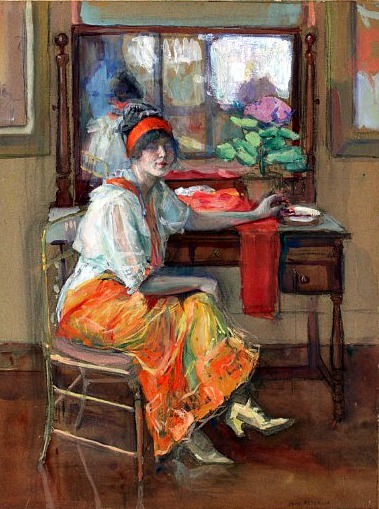
Jane Peterson, Painter


When I first saw Jane Peterson’s paintings, I immediately fell in love with them.  I soon learned why her work appealed to me.  Her unique Post-Impressionist style was derived from direct study or association with many of the leading bravura and avant-garde painters in the early years of the 20th Century – painters that I also love, including Joaquin Sorolla y Bastida, who had the most profound influence on her work.  She traveled to Madrid in the summer of 1909 to work with the great Spanish Impressionist.  He urged her to paint with brilliant color, and she eagerly accepted his advice.  In 1910, again at Sorolla’s encouragement, Peterson went by herself on a painting expedition to Egypt and Algiers, a daring move for a woman painter traveling alone.  In December of that year she firmly established her reputation as a major American Post-Impressionist with a large solo exhibit at the Art Institute of Chicago.  Before studying with Sorolla, she had studied with Frank Brangwyn in London and Jacques-Emile Blanche in Paris, both exceptional bravura painters themselves.  Peterson’s friends and colleagues included Maurice Prendergast, who painted many of the same subjects she painted early on, John Singer Sargent and Childe Hassam.

Jane Peterson about 1928
Peterson, born Jennie Christine Peterson in Elgin, Illinois in 1876, began her career as a public school art teacher after studies at Pratt Institute with Arthur Wesley Dow and The Art Students League with Frank Vincent DuMond.  But she found teaching in public schools a bit dull, and in the summer of 1907 she made her first trip to Europe in the company of Henry Snell, one of her teachers at Pratt, and his artist wife.  When the couple returned to America, Peterson stayed behind.   This strong, independent woman seemed to meet everybody she wanted to in the art world and travel anywhere she liked to paint on her own -- Brittany, Venice, Egypt, Turkey, you name it, she was game -- from 1908 to 1925, the most adventurous years of her long career.

In Paris, Peterson stayed in Montparnasse, the district that attracted artists from all over the world because studios were plentiful and cheap.  She lived right around the corner from Gertrude Stein’s salon and was a regular at the gatherings hosted by Gertrude and her brother Leo, whose other guests included Pablo Picasso, Henri Matisse, Andre Derain and many other important modern artists and art lovers.  For many years, Peterson made annual summer trips to Europe, except during the years of America’s involvement in World War I.  In America she painted at the popular artists’ colonies of Gloucester, Massachusetts; Edgartown, Martha’s Vineyard; and Ogunquit, Maine.  She worked in oils, gouache and watercolor.  The fast-drying medium of gouache allowed her to quickly experiment with broad strokes of color when working en plein air. Between 1913 and 1919, Peterson was a watercolor instructor at the Art Students League.   During World War I, she painted war-oriented subjects for the benefit of Liberty Loans and the American Red Cross.  


Her routine changed abruptly in 1925 when she married Moritz Bernard Philipp, a prominent corporate attorney 25 years her senior.  She divided her time between their townhouse at 1007 Fifth Avenue, across the street from The Metropolitan Museum of Art, and Rocky Hill, Philipp’s summer retreat in Ipswich, Massachusetts.  A sixth floor was added to the Fifth Avenue townhouse for her use as a studio.  She began cultivating flowers, and for the rest of her career she concentrated on painting brightly colored floral still lifes in direct attacks on canvas with bold brushwork.
 
Turkish Garden from Tiffany Estate
She had always loved painting flowers and flower gardens.  In 1911, she had accepted Louis Comfort Tiffany’s invitation to paint his magnificent gardens at Laurelton Hall, Oyster Bay, New York.  She spent several months painting there, and went on painting excursions with him, as well.  I imagine that this opportunity came about because of her studies with Sorolla, who painted Tiffany’s portrait in those gardens that same year.

Regarding her feelings for the flowers she loved to paint, Peterson wrote in the September 1922 issue of “The Garden Magazine” that flowers “scintillate the prismatic hues of the rainbow; they harmonize the pastel shades of the night; they are all that is delicate; all that is lurid, brilliant, bizarre. They are living things with personality and refinement, with delicacy of form and structure, with variety of size and shape, with rhythm and charm of arrangement, with grace and dignity of bearing.”  That’s quite a mouthful, but as a painter who loves the challenge of painting ephemeral cut flowers myself, I understand her passion.

At Rocky Hill, Peterson completed many floral, beach, and pier scenes. After her husband’s death in 1929, Peterson resumed her studies and travels abroad. In 1939 she married her second husband, James S. McCarthy, a prominent New Haven physician. They separated within a year, and then divorced.  Peterson's hands became crippled with arthritis in the mid-1950s and she painted much less frequently.  She spent the last five years of her life with her niece in Kansas, who took care of her until she died on August 14, 1965, at the age of 88.   Here are some of the paintings she created in her prime:

Paris Carousel, 1908

Luxembourg Gardens, 1908

Paris Flower Market
Biskra, North Africa


Self-Portrait


Spring Bouquet, 1912, 40 1/16 x 30 in., PA Academy of Fine Art


Detail


Sunday, August 4, 2013

Anatomy Lessons


I spent a month in the spring of 1979 in the 2nd floor studio of the revered anatomy instructor Robert Beverly Hale (1901-1985) at The Art Students League, often dozing off in the growing warmth of the afternoon as he pointed out the bones and muscles of the human body on large anatomical charts.  After the lectures he let us do a little drawing from the model.  He offered some individual guidance to his most devoted students.  I was not one of them.

In addition to teaching at the League, Hale was the first curator of American Paintings and Sculpture at The Metropolitan Museum of Art, a position he held since the department was founded in 1948 until his retirement in 1966.

When Hale retired from the League in 1982 after some 40 years of teaching, two of his top students immediately took his place, basing their instruction on his lectures.  Hale taught drawing and “Artistic Anatomy,” the title of an essential book on the subject written by the French anatomist, physiologist and artist Dr. Paul Richer (1849-1933), who was professor of artistic anatomy at the Ecole des Beaux-Arts in Paris.  Richer’s book was published in 1890.  Hale translated and edited the highly regarded English language version, which was first published in 1971.   

While the study of anatomy never appealed to me, I did enjoy perusing this book when I was younger and full of energy for exploring everything related to drawing and painting.  And I can tell you that Richer’s simplified drawing of the ear made the construction of this convoluted appendage immediately clear to me for the first time.   Many of us learn to paint the eyes, nose and mouth acceptably, but only the best figure and portrait painters can do a good job when drawing and painting the human ear from life. 
  
Hale’s lectures were videotaped at the League in grainy black and white in 1976, apparently with no thought other than to provide a low-budget historical record of them, which his many devoted students felt contributed immensely to their development as artists.  All ten lectures are now available as a DVD set for a mere $799 from someone very close to the scene who snared the copyright on the tapes in 1997.  At that price, the copyright holder, Jo-An Pictures Ltd, has apparently decided to market the set of lectures primarily to educational institutions, where students and others can view them at no cost.  But judging from comments on the Internet, the exorbitant price for the full DVD set, over 13 hours of viewing, has angered many former students and admirers of Hale.  They believe the lectures should be available at low cost to all interested students and artists, in the same spirit as they were initially transcribed.  I’m curious as to how this power grab came about, but not curious enough to do any further research into the matter.  Some bits of the lectures are available free on various Internet websites, but Jo-An Pictures Ltd. has established strict guidelines with regard to duplication and public performance rights.  So thereby hangs a minor tale in the irritable bowels of art history. 


Hale’s lectures were delivered with the elegant patrician authority to be expected from this descendant of a prominent New England family, whose grandfather was Edward Everett Hale, author of “The Man Without a Country.”  I just wasn’t that interested in the subject.  I tended to accept the judgment of Frank Mason, who taught painting along the lines of Rubens at the League and had a large and enthusiastic following himself.  Musing one day from his more rarefied perch in the big north light studio on the 4th Floor, Mason said, “There’s a man teaching on the second floor who knows the name of every bone and muscle in the body, but he can’t paint them.”  Those of us who paint directly from nature feel that if you do a lot of life drawing from the model, you will be able to paint and draw the figure well enough without the kind of thorough anatomical study Hale was preaching.


On the other hand, artists who create drawings and paintings of the human figure entirely from memory, or apply anatomical features in an obvious, decisive way when drawing from the live model, have a much different attitude about Hale’s instruction.  When I’m in an open sketch class at the League and voice my disgust with the ugly cast shadows on the model caused by careless lighting, someone sitting next to me always proposes that I make up my own pattern of light and shade, as Hale used to advise.  Easier said than done.  Often the figures these anatomy loving artists produce, when drawing from memory or from life, with all the exaggerated muscles in approximately the right place, don’t look quite human, but that doesn’t seem to bother them one bit.  One of Hale’s most devoted students used to draw from the model in charcoal or conte crayons with one hand while holding an open book of Old Master drawings in the other to help him with his “Rubenesque” drawings.


There are lots of bones and muscles in the human body, and it can drive you a little crazy if you really dig into the subject of anatomy.  Especially unnerving to me are artists who feel the need to visit morgues and observe dissections in medical schools to improve their knowledge of anatomy.


Theodore Gericault, The Raft of the Medusa, 1818-1819
Oil on Canvas, 193.3 in. by 282.3 in.
Gericault visited morgues and hospitals to study the flesh tones of the dead and dying in preparation for his greatest painting, “The Raft of the Medusa,” which shows his friend Delacroix posing as the corpse lying face down, one arm outstretched, in the center foreground of the huge composition.  Gericault even reclaimed for further study severed limbs and one severed head, which were left to decay in his studio.  Gericault died in 1824 at the age of 32 of chronic tubercular infection in Paris after a long period of suffering.   I don’t suppose rotting body parts lying around in the studio had anything to do with his suffering and untimely death. 


During the month that I was attending Hale’s class, there was a tall, handsome young man who stayed after class every day to collar Hale regarding some specific muscle attachment or other.  He was the picture of youthful, scholarly enthusiasm as he pressed Hale for answers to his questions.  Not long after I left Hale’s class, this young man started to hang around the front of the League building looking increasingly disheveled and out of sorts.  Pretty soon he was becoming a public nuisance.  One summer morning I was painting in Central Park when he came rushing out of the bushes, all wild hair and flashing eyes, bare to the waist, his tattered trousers nearly falling off, and shouted in my face, “I know you!”  Naturally, I was taken aback, and quite frightened, actually.  But luckily that outburst was the climax of our encounter.  I managed to say a docile “hello” or something, and he wandered off into the bushes from whence he had come.  By the way, that incident took place when Central Park was far less manicured and fenced off than it is today and far more agreeable for painters.  The young man’s social skills continued to deteriorate.  He surfaced occasionally in either a normal or a deranged state, before eventually disappearing from the scene entirely. The young man was very likeable and I always hoped that he would get some treatment to rid him of whatever demons were afflicting him.  I don’t really believe the cause of his anguish was taking the study of anatomy too seriously.  But you never know. 


When artists become too preoccupied with the study of any of the components of representational painting they aren’t going to hit many home runs on canvas, in my opinion.  I often think of Chardin’s remark to a fellow painter who was going on and on about the colors he was using.  After awhile, Chardin became annoyed and said, “Yes, yes, we use colors, but we paint with feeling.”  His words have sustained me through the years.  When I read about artists working for weeks on a painting as they render the smallest details to photographic perfection, I often wonder what emotional state they are in during the process.  I would guess they can’t let their emotions get the better of them as they plod along to the finish line. 


Can you paint a really great picture without experiencing alternating waves of euphoria and despair during its creation?  I don’t believe so.  We have read quite a lot about the emotional state of painters from days gone by, but very little about their working methods.  It’s just the reverse today.  Painters are constantly publicizing their latest creations with blow-by-blow accounts every step of the way, mit still images und video.  But we hear very little about the interesting stuff -- their psychological makeup when they were in the passionate throes of artistic creation.  That moment when they were ready to slit their wrists.  Degas once said, “There is a kind of success that is indistinguishable from panic.”  All we hear from the painter today is he used so and so’s high-end brushes and oil colors and painting supports to paint his photographic pastiches in the presumed exact same technical manner as one of the Old Masters, mit many glazes und many scumbles.  Maybe passion has left the building.   


Joseph Henry Sharp, The Marigolds, Oil on Canvas, c. 1940, 25" x 30"

One of the many charming songs the brilliant American songwriter Frank Loesser wrote for the 1952 movie “Hans Christian Andersen” perfectly describes a significant element missing in the paintings of today’s photographic renderers:

Inchworm, inchworm
Measuring the marigolds
Seems to me you'd stop and see 
How beautiful they are